A visual spine runs alongside the story: two strands, the Fox family and the Lebov family, tied together at each documented contact between 1903 and 1913, then running close but untied afterward, the honest edge of the record.
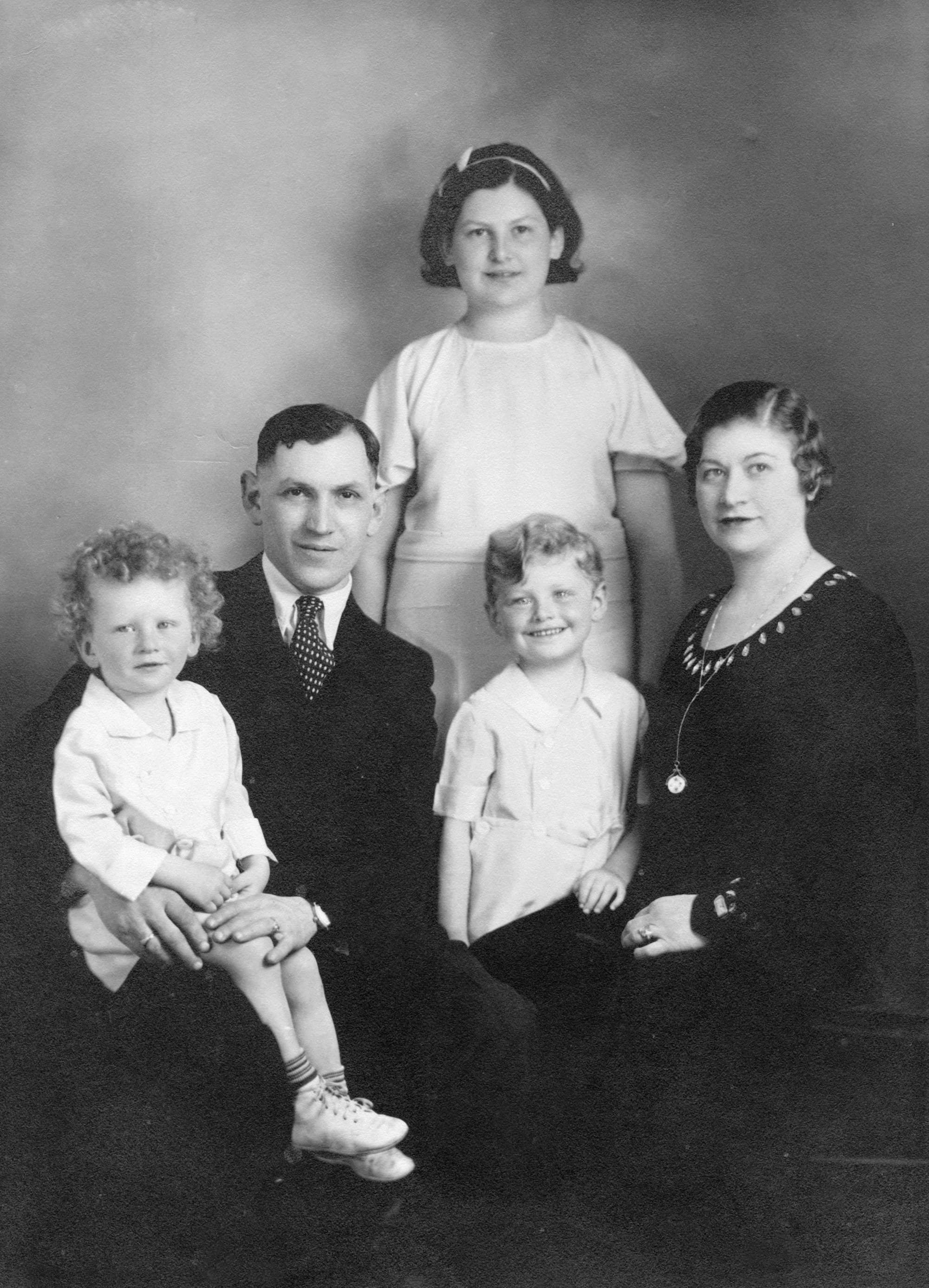
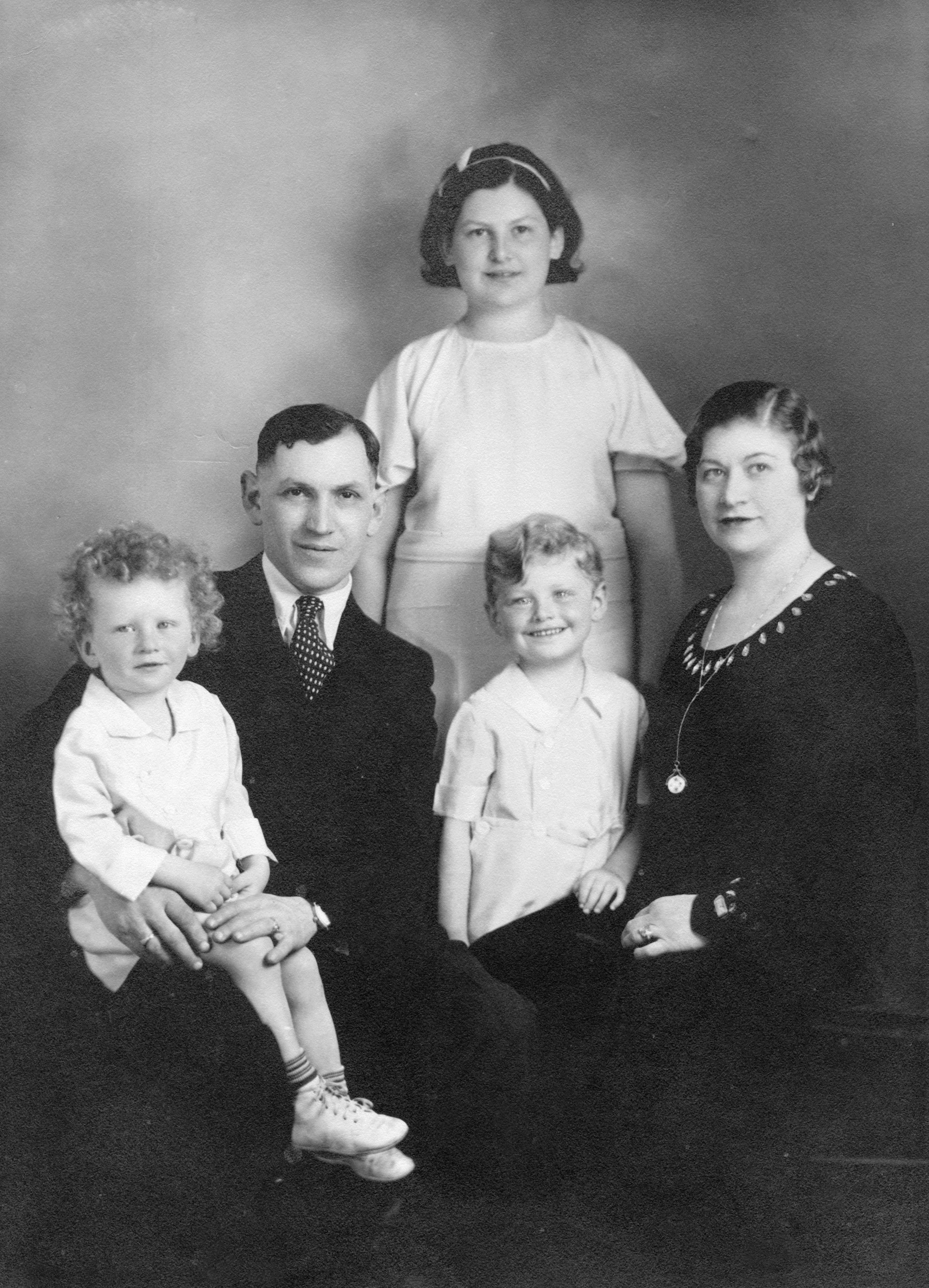
- Albert Fox and Esther Burd Fox, with their children Leona, Roland, and Charlie.
What I knew at the start
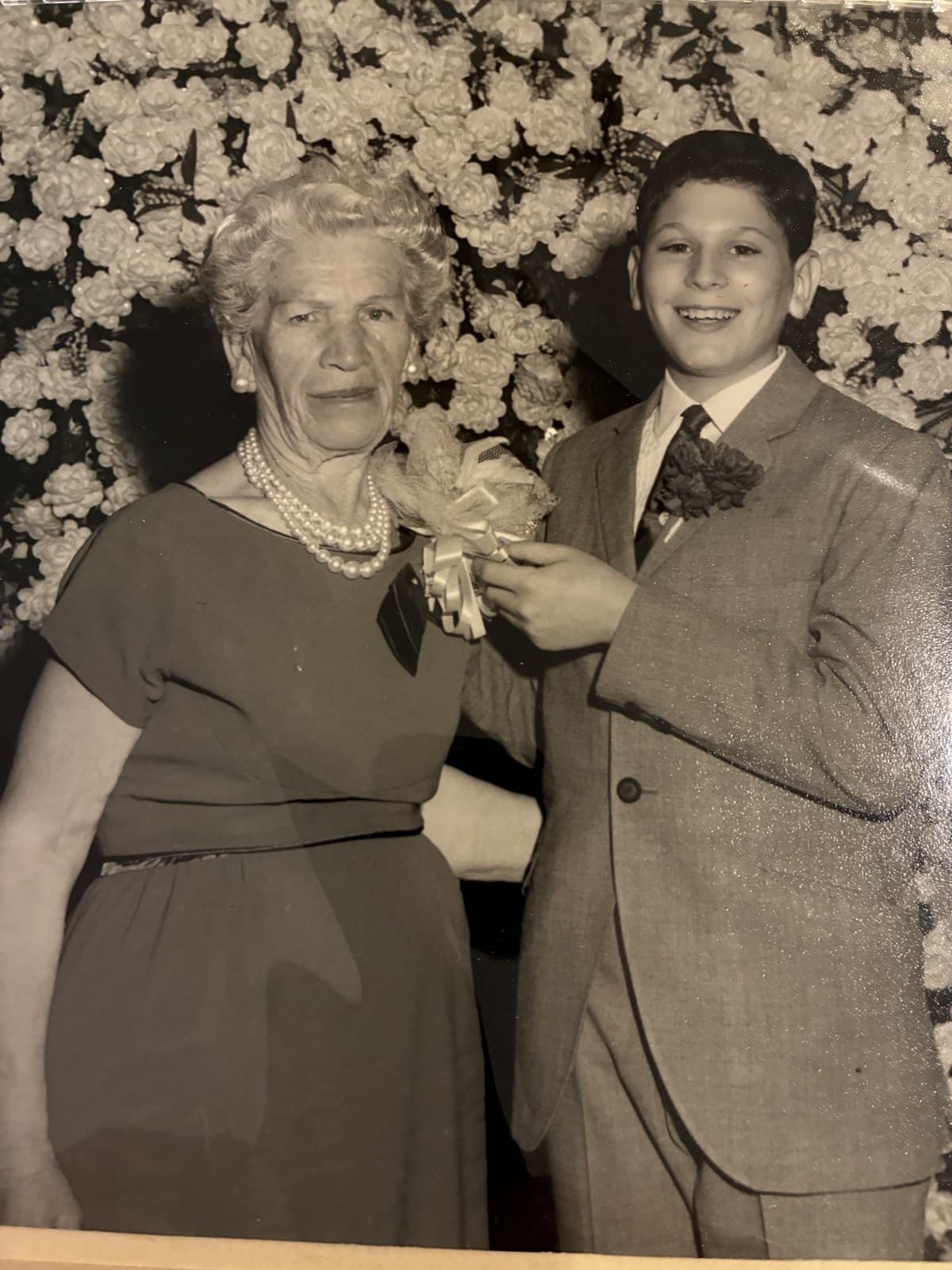
This photograph represents where my knowledge of the Fox family began: Albert Fox and Esther Burd, with Leona, Roland (my grandfather), and Charlie.
Albert
◦ born 1892
Esther
◦ born 1898
Leona
◦ born 1921
Roland
◦ born 1930
Charlie
Albert, Esther, and their three children is basically all I grew up knowing about. The rest of this story is about how far I've been able to expand that understanding, what it says about the lives they lived, and how the family stayed connected years longer than I expected.
For years, a photograph stood in for my great-great-uncle Harry Fox: three young men in front of the palms of the Belle Isle Conservatory in Detroit, around 1917. I had assumed the man standing in the middle was Harry, because on the right of the photo was my great grandfather Albert Fox, and on the left was their brother Ervin Fox.
That was a mistake. When the faces were finally checked, the man seated on the left matched Harry's brother Ervin, but the man standing in the middle was definitely not Harry.
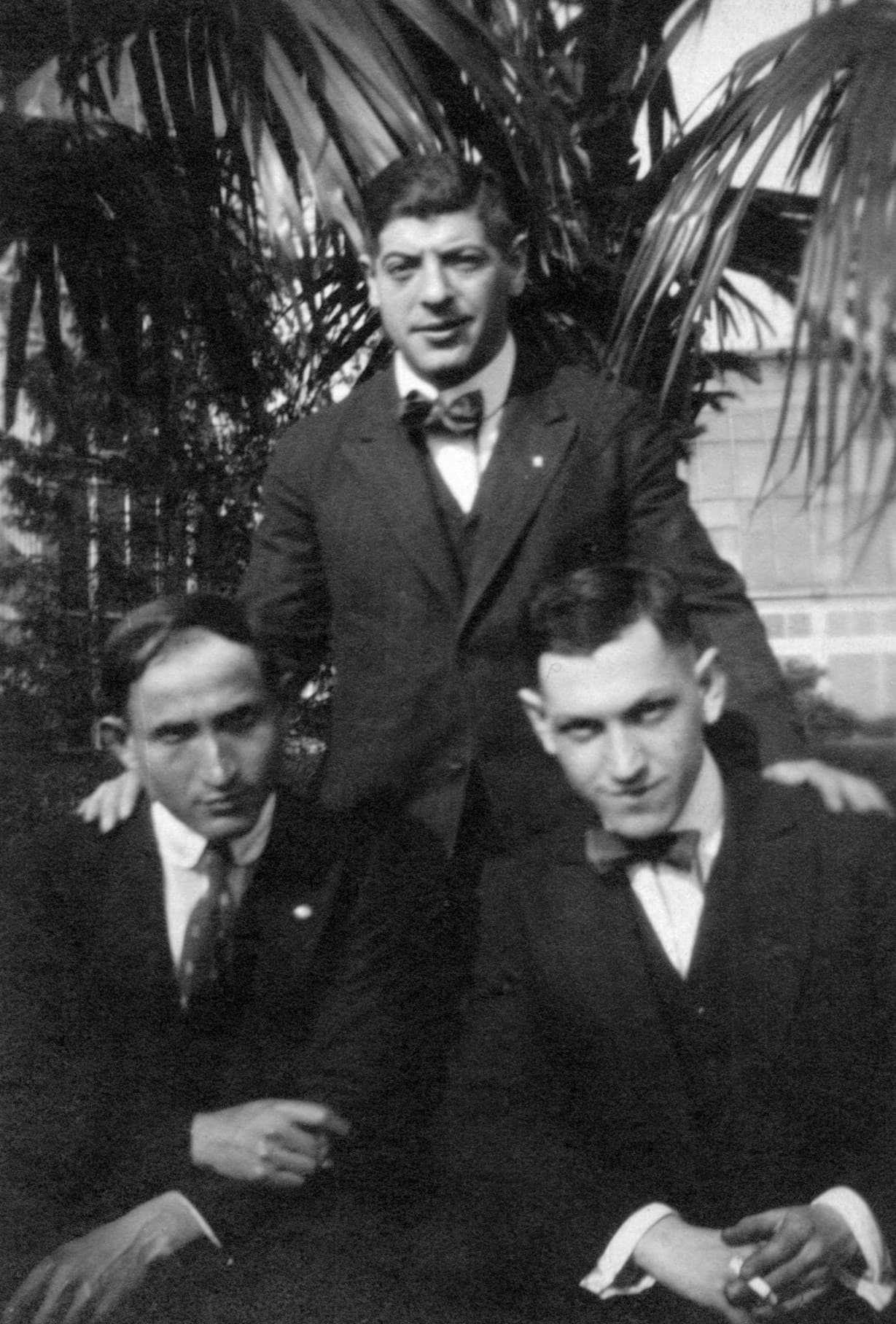
The label was wrong. The photograph never changed; what we knew did.
As part of the facial recognition work I've been doing on old family photos, I went looking for confirmed photos of all of Albert Fox's siblings, and set each one beside the three Belle Isle faces.
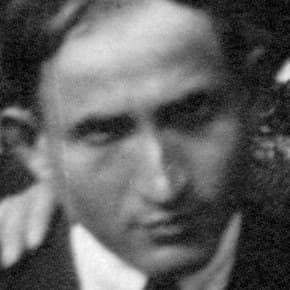
Ervin's photo matched.
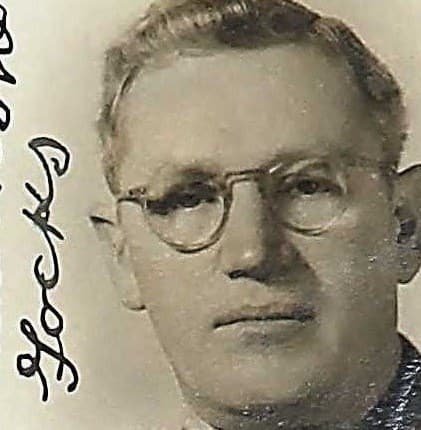
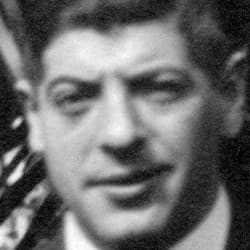
Harry's photo did not match.
So the standing man is not Harry. Harry's definitive photo was found elsewhere, pasted to one of his naturalization forms.
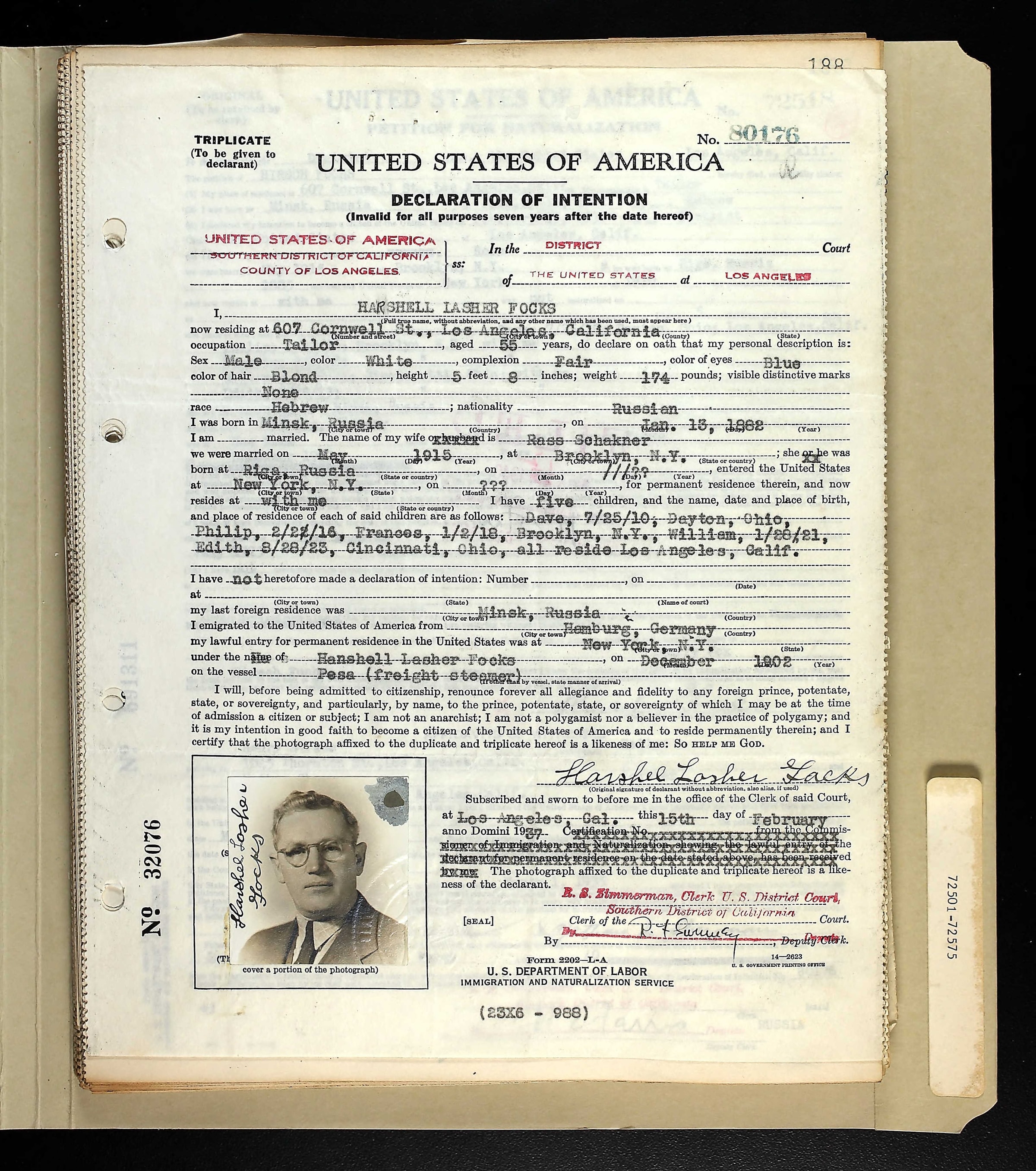
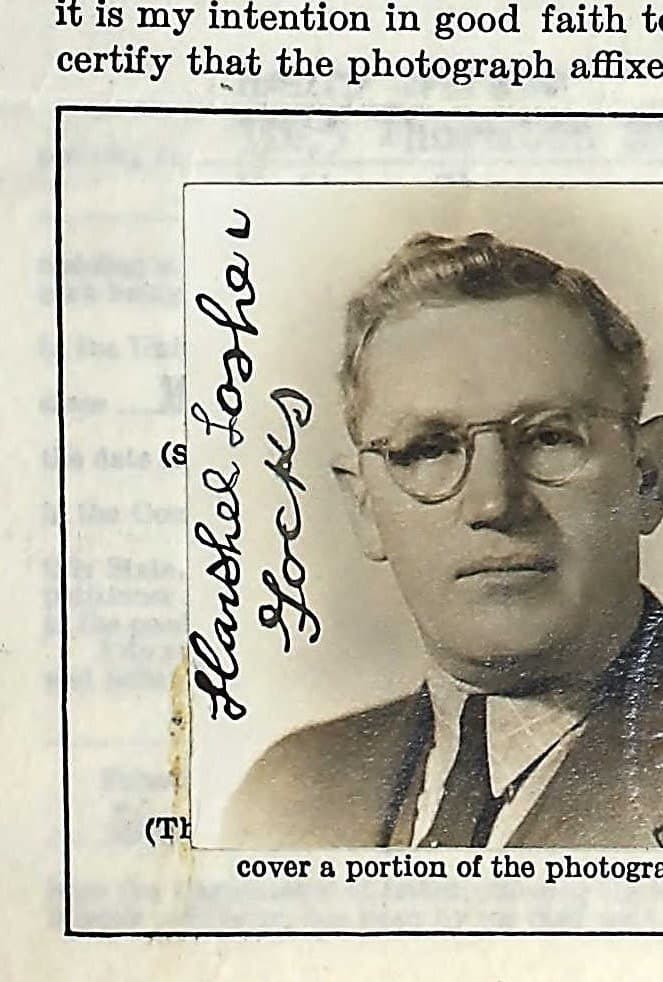
Harry Fox, in the photograph affixed to his Declaration of Intention
Going sibling by sibling looking for confirmed photos from online sources and cousins, I found a photo of Harry pasted to one of his naturalization forms, his signature looping across it.
Harry Fox
Harshell Lasher Focks
The name he immigrated under, typed across the top of his own declaration.
at Los Angeles, Cal., this 15th day of February ... 1937
He filed it in Los Angeles on February 15, 1937.
on the vessel Pesa (freight steamer)
Then there was the one detail that sent me down the rabbit hole, the information about his passage to America.
Harry Fox · confirmed
Knowing his face allows us to identify more family and tell more stories.
- Albert Fox and Esther Burd Fox, with their children Leona, Roland, and Charlie.
- Albert was one of Meyer Fox and Reva Heft's eleven children, oldest to youngest: Yudel Noson, Harry, Bessie, Sarah, Sadie, Malka, Rachel, Albert, Leyba, Ervin, and Jack. Eight survived to adulthood; Yudel Noson, Malka, and Leyba died young.
The family I knew: Albert and Esther, with Leona, Roland, and Charlie.
Albert's own parents were Meyer Fox and Reva Heft. The family I knew was one branch of a much larger tree.
Albert was one of Meyer and Reva's eleven children. Eight survived to adulthood.
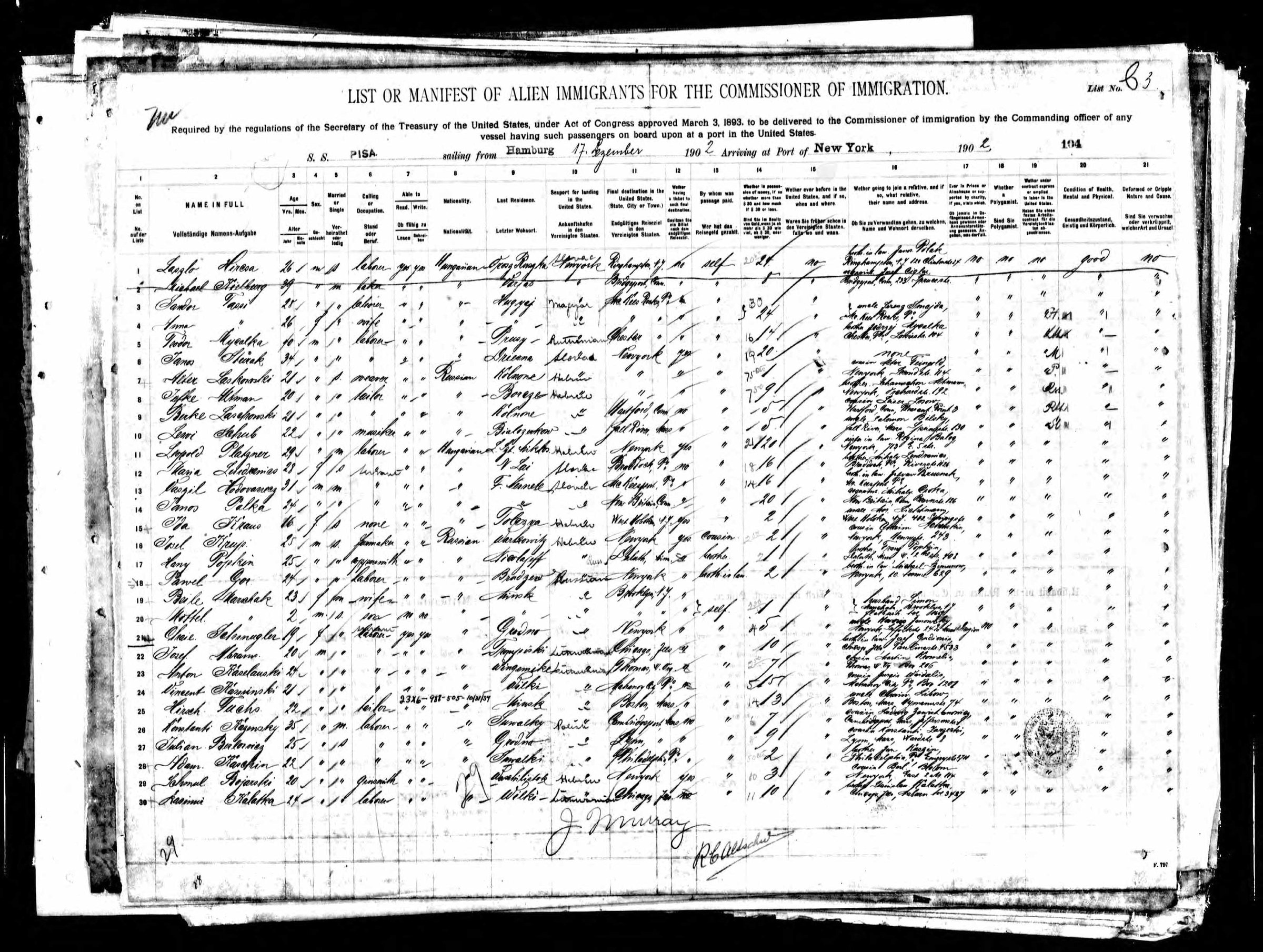
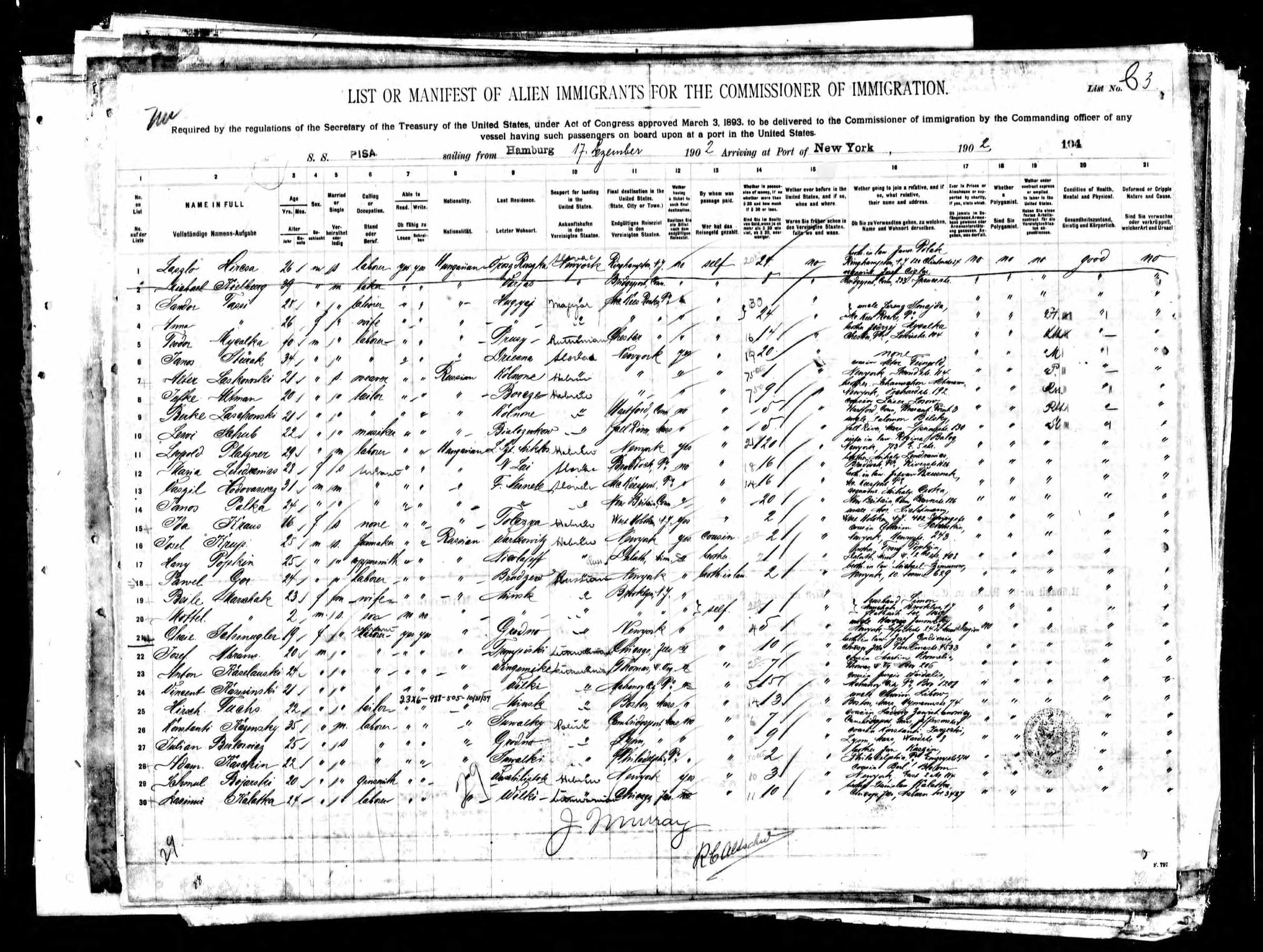
Harry left Minsk in December of 1902. On the Hamburg steamer Pisa's manifest, which arrived in New York on January 2, 1903, he is listed as Hirsch Fuchs, a tailor. The family name Fuks/Fuchs is an ornamental surname that means Fox in Yiddish. In column 18, where the clerk recorded whom each immigrant was going to join, there is a name that made no sense based on what I knew about the family at the time.
The anomaly
Harry's manifest sends him not to his own father but to Boston, to an uncle named Chaim Lebow.
Hirsch Fuchs
Line 25. Harry, under the name he was born with, listed as a 22-year-old tailor.
On the family treeHarry Fox, Meyer & Reva's sonMinsk
The city his family had lived in for generations.
Boston, Mass
Boston, not New York, where his father Meyer settled.
uncle Chaim Lebow Boston, Mass, [H/L]yman Str 74
Harry was going to join an uncle named Chaim Lebow.
◦ The surname is also readable as 'Libow'; the street's first letter is genuinely ambiguous (H or L). Shown as written. Three days earlier, another Minsk arrival was sent to 'uncle Hyman Lisitsky, 74 Brighton St'; the matching house number is part of how we identified the man behind this scrawl.
Number 74
An uncle named Lebow was surprising. We have a pretty strong understanding of all Meyer's siblings. The Fox side of the family is documented across generations in Minsk records and validated with extensive DNA evidence. There is no Lebow among them. If this uncle was actually blood related, the likeliest place to look was the other side: Harry's mother, Reva Heft. While we knew a lot about the Heft family history in Minsk going back several generations, we had very little knowledge about what happened to her family going into the 20th century.
- Albert Fox and Esther Burd Fox, with their children Leona, Roland, and Charlie.
- Albert was one of Meyer Fox and Reva Heft's eleven children, oldest to youngest: Yudel Noson, Harry, Bessie, Sarah, Sadie, Malka, Rachel, Albert, Leyba, Ervin, and Jack. Eight survived to adulthood; Yudel Noson, Malka, and Leyba died young.
- A Boston uncle, named only as 'uncle Chaim Lebow' on Harry's 1903 manifest, floats unconnected, his identity not yet known.
What did ‘uncle’ mean in 1903?
On records from the Russian Empire, families often called any close kin an uncle. The word on Harry's manifest stays open.
uncle
- a mother's brother
- a father's brother
- an older cousin
- close kin: mishpucha, family in the wider sense
There is one more clue in that scrawled address, and it took a second manifest to see it. Three days before Harry landed, on December 30, 1902, the S.S. Belgravia arrived in New York carrying another young man from Minsk: Schmul Libow, who America would come to know as Sam Lewis. The clerk on Sam's manifest wrote his destination plainly: uncle Hyman Lisitsky, 74 Brighton St., Boston. The 1902 Boston city directory lists Hyman Lisitzky at that same address.
Harry's clerk wrote what looks like "[H/L]yman Str 74". I could not turn that scrawl into a street name, and I am not going to pretend I can, so we show it as written. But two different clerks, three days apart, both wrote down the same house number, 74. That number is what let me line the two ships up against each other.
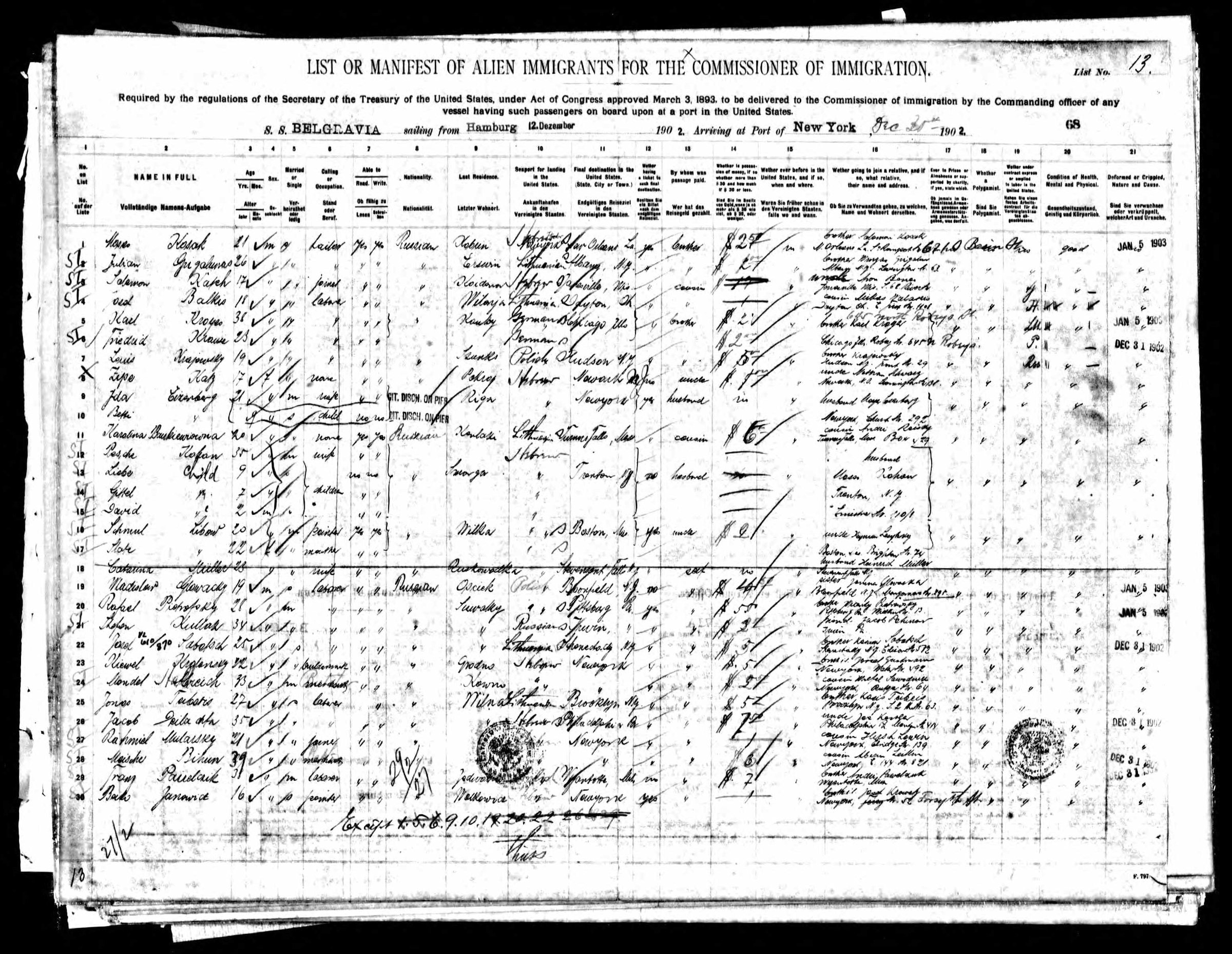
Schmul Libow
Line 16. Sam, age 20, three days ahead of Harry.
uncle Hyman Lisitsky Boston, Mass. Brighton Str. 74
Sam's clerk wrote his uncle's name plainly: Hyman Lisitsky, 74 Brighton Street, Boston. The house number matches the scrawl on Harry's manifest.
One house number, written into three records.
The same address, 74, surfaces on both manifests and in the city directory. It fixes the house number, not the street; Harry's scrawl stays as written.
- Harry's Pisa manifest, 1903as written, ambiguous
- Sam's Belgravia manifest, 190274 Brighton St
- 1902 Boston city directoryh. 74 Brighton
The house number 74 appears in three records: on Harry's 1903 Pisa manifest (as written, ambiguous), on Sam's 1902 Belgravia manifest (74 Brighton Street), and in the 1902 Boston directory (74 Brighton). The shared number is what lines the records up; the street itself stays unresolved.
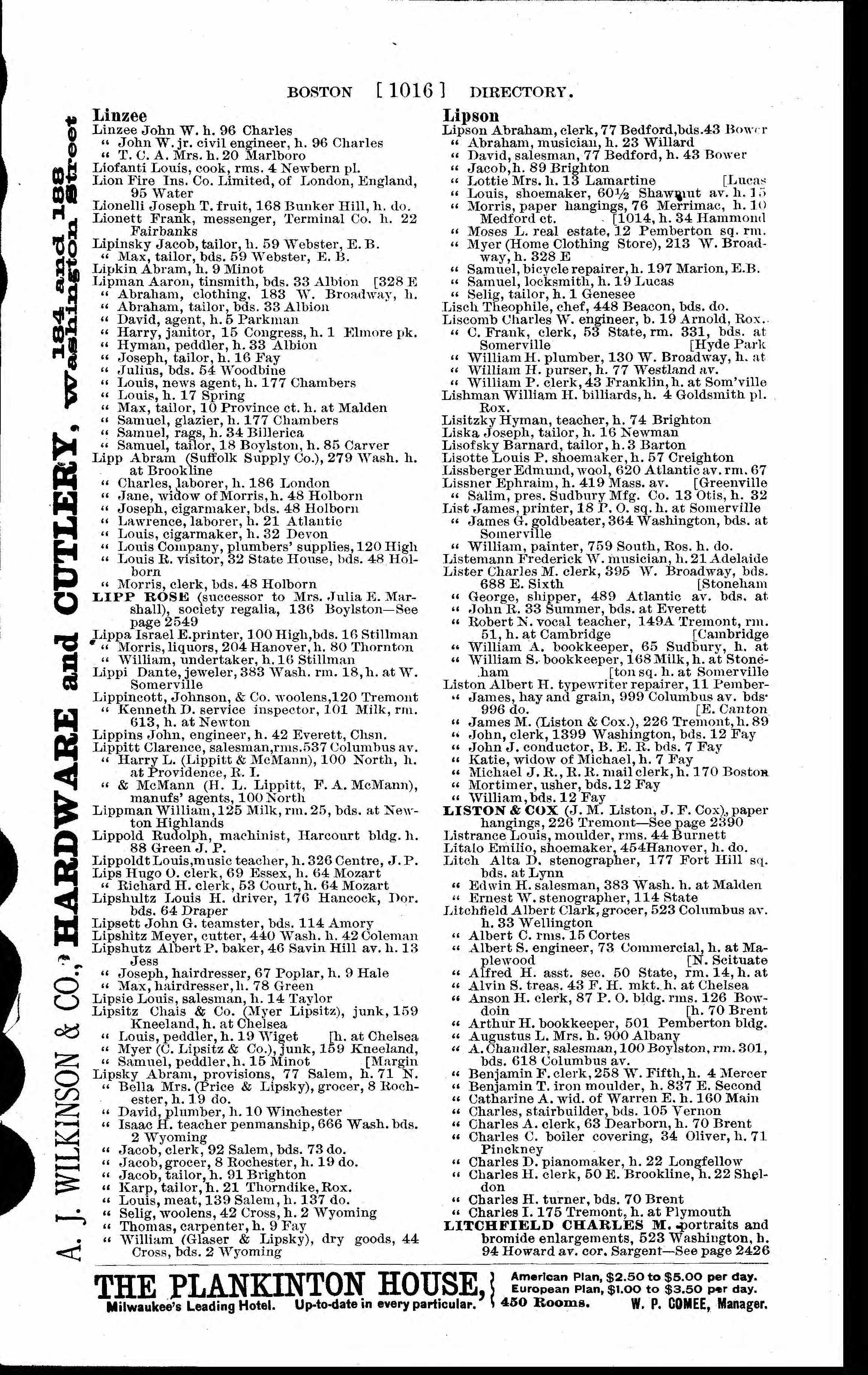
The 1902 city directory
The house number was not a clerk's guess. The 1902 Boston directory puts a real man at that address.
Lisitzky Hyman, teacher, h. 74 Brighton
The directory lists Hyman Lisitzky, a teacher, at 74 Brighton Street.
And there was a third. In January 1908, a young woman named Chayke Libow arrived from Minsk, and her manifest sent her to a Boston uncle too, written this time as "uncle Chaim S. Lisitzky," at a new address now that the household had moved. Three young travelers from Minsk across six years, Sam in 1902, Harry in 1903, and Chayke in 1908, were each pointed to a Boston uncle, written down under the names Lisitzky and Lebow both.
Put the three arrivals beside the 1902 directory and the strongest reading, about 90 to 95 percent by the records we hold, is that the Boston uncle was the man the city knew as Hyman Lisitzky, one man under two surnames. The family tree now has it that way. The records point there, and it is very likely, though not locked. very likely
One family, two record names
The Boston uncle
Chaim Lebow / LibowHyman / Chaim S. Lisitzkyvery likely, not lockedRussian-Empire Jewish records often show one family under more than one surname. Sometimes that was to dodge the draft. Sometimes the name changed by how a clerk heard it. Here I only know the names doubled, the same name written two ways, and it comes back on Reva's side.
The paper trail could not tell me how this Lebow family connected to ours. So I turned to the DNA.
First, were the Lisitzky and Lebow families actually related to each other by blood, or just friends or associates? A tested descendant of the Lisitzky line and a tested descendant of the Lebow line share 103 centimorgans of DNA. A centimorgan is the unit used to measure how much DNA two people share, and 103 is a lot, even for Ashkenazi Jews from the same town, where generations of marrying inside a small community leave almost everyone sharing a little. The two families were definitely closely related.
DNA across the two families
103 cM
longest segment 25 cM
Shared-match clustering, not chromosome triangulation. Ashkenazi endogamy inflates shared DNA, so the centimorgans are read with care. But 103 cM, with a 25 cM longest segment, sits well above the background-relatedness floor. The two families were closely related by blood, even if the DNA can't say exactly how.
The Next Line
Second, how did the Lebows connect to us? Two members of the family had tested: my great uncle Charles Fox and his cousin Alan Newman, descendants of Meyer and Reva through two different children. If a stranger's descendants matched closely to both kits, the connection very likely ran through Meyer or Reva rather than some other branch.
One cluster of shared matches stood out. Mutual DNA matches led back to one woman: Sivia Lebov of Boston.
What the DNA showed
Charles Fox
descendant of Meyer & Reva,
one branch
Alan Newman
descendant of Meyer & Reva,
another branch
one shared match cluster
the matches lead back to…
Sivia Lebov
of Minsk, then Boston · 1887–1966
Match-cluster analysis on AncestryDNA. In endogamous Ashkenazi communities, shared DNA alone overstates closeness. What carries the weight here is that the documented family trees of the shared matches independently converge on Sivia.
- Albert Fox and Esther Burd Fox, with their children Leona, Roland, and Charlie.
- Albert was one of Meyer Fox and Reva Heft's eleven children, oldest to youngest: Yudel Noson, Harry, Bessie, Sarah, Sadie, Malka, Rachel, Albert, Leyba, Ervin, and Jack. Eight survived to adulthood; Yudel Noson, Malka, and Leyba died young.
- The Boston uncle, now very likely identified as Hyman Lisitzky (1862 to 1913), still floats unconnected; whether he was a literal blood uncle is an open question.
- A separate family: Iudel-Leiba Lebov and Sora-Malka, with their children Genya, Sam, Sivia, and Chayke.
Mutual DNA matches kept leading back to one Boston family.
They led back to one woman: Sivia Lebov.
Sivia had siblings: Genya, Sam, and Chayke.
Iudel-Leiba and Sora-Malka, and a whole second tree, still floating unattached.
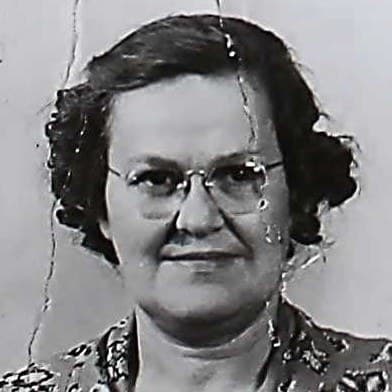
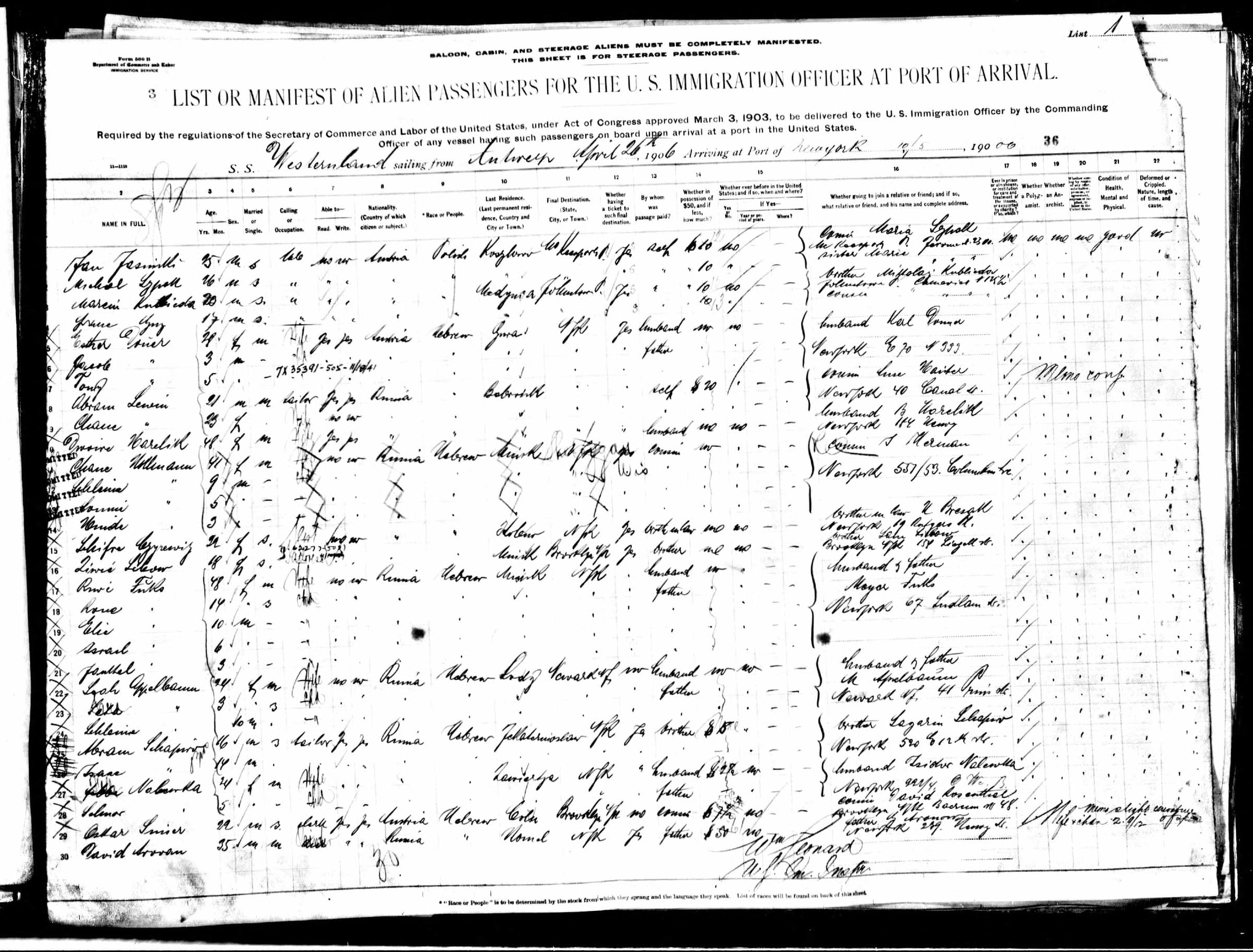
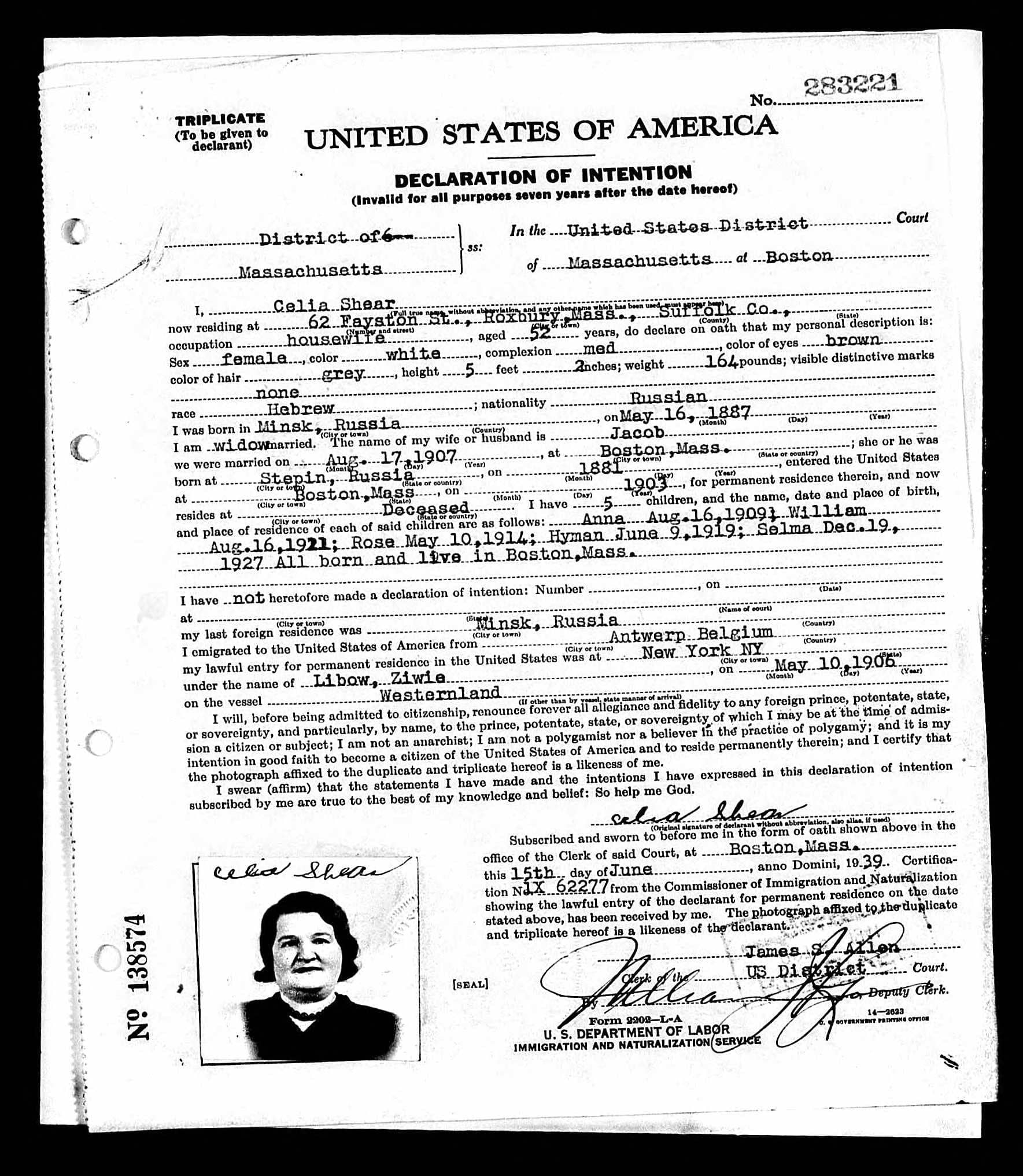
Like Harry, Sivia left a paper trail of her own. Her Declaration of Intention carries her photograph, and it names the ship that brought her over.
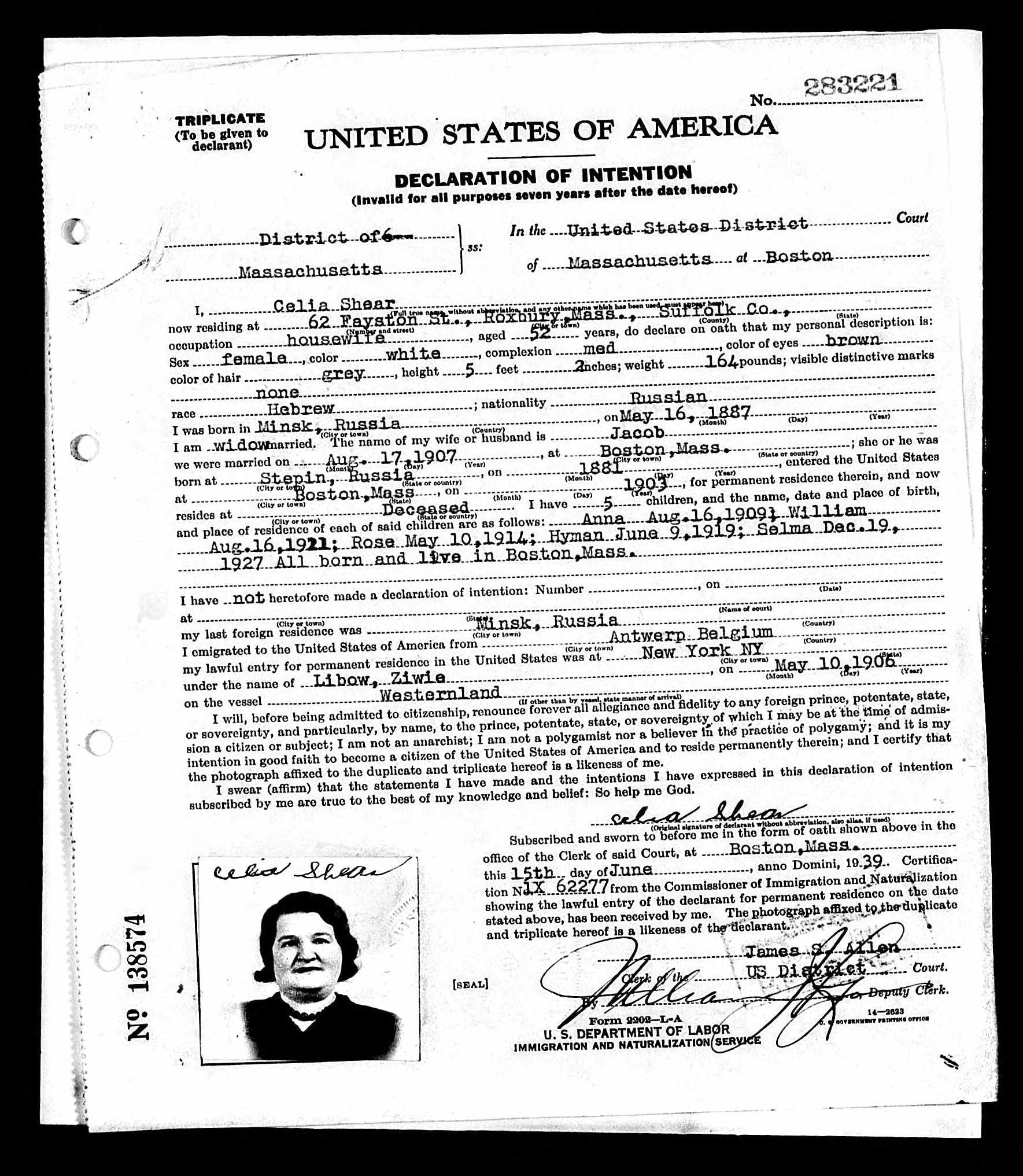
Sivia's own declaration
By the time she filed, Sivia was Celia Shear, a widow in Roxbury. The form still carries the names she started with.
Celia Shear
Sivia herself, in the photograph affixed to her declaration.
under the name of Libow, Ziwie
She immigrated as Ziwie Libow, the same Sivia Lebov. Later records carry her as Celia Shear, and then Celia Landy.
on the vessel Westernland
The ship that brought her over was the Westernland, out of Antwerp.
New York, N.Y. · May 10, 1906
Arrived New York, May 10, 1906.
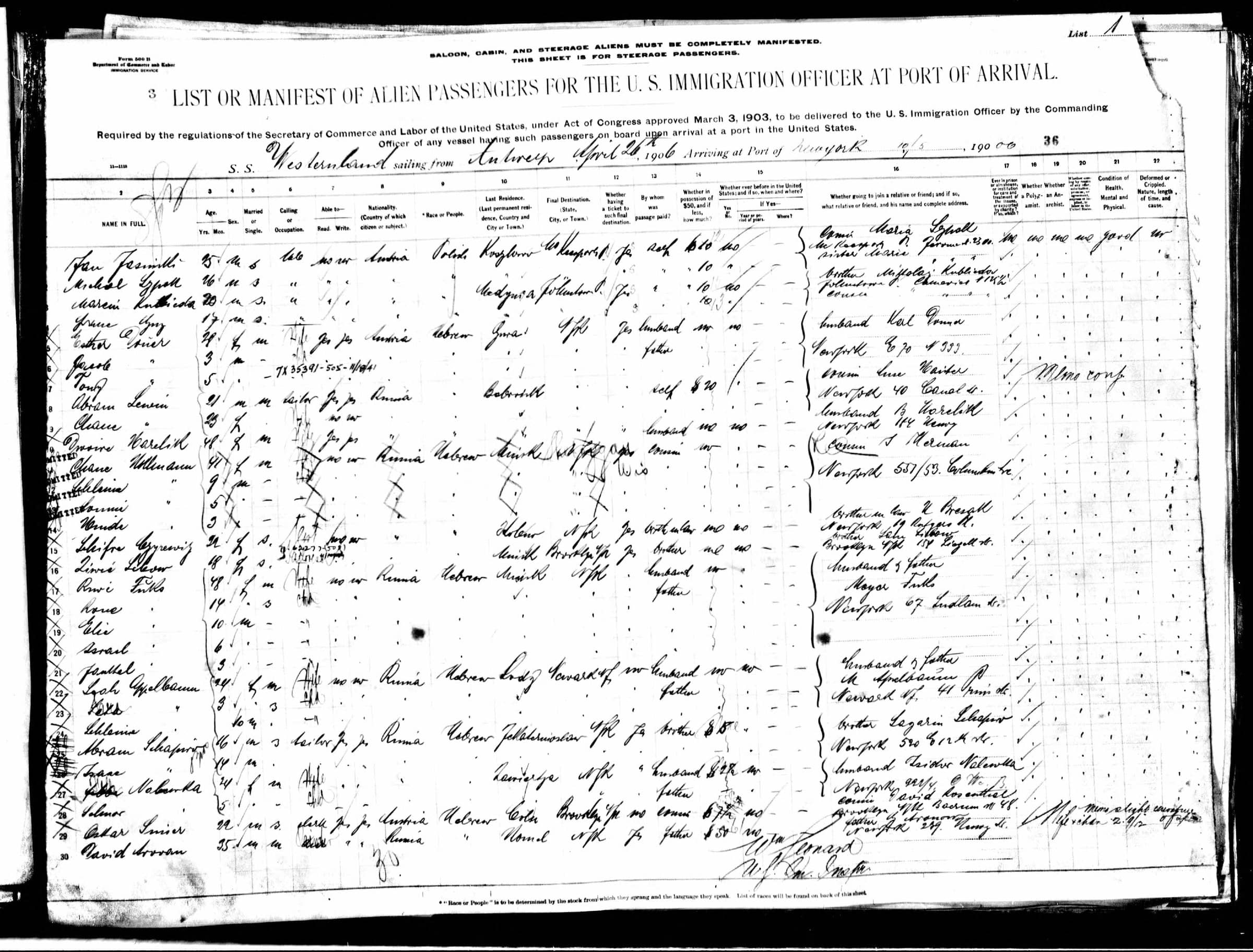
So I pulled that passenger list. The S.S. Westernland arrived in New York on May 10, 1906. Sivia is on line 16, and Reva is on line 17, the very next line, in the same clerk's hand, with Reva's four children written down the rows beneath her. You can put a finger on Sivia's name and move it down one line to Reva without lifting it off the page. They came from the same city, and they crossed the ocean written into the book back to back. How Sivia connected to Reva is where the records go next.
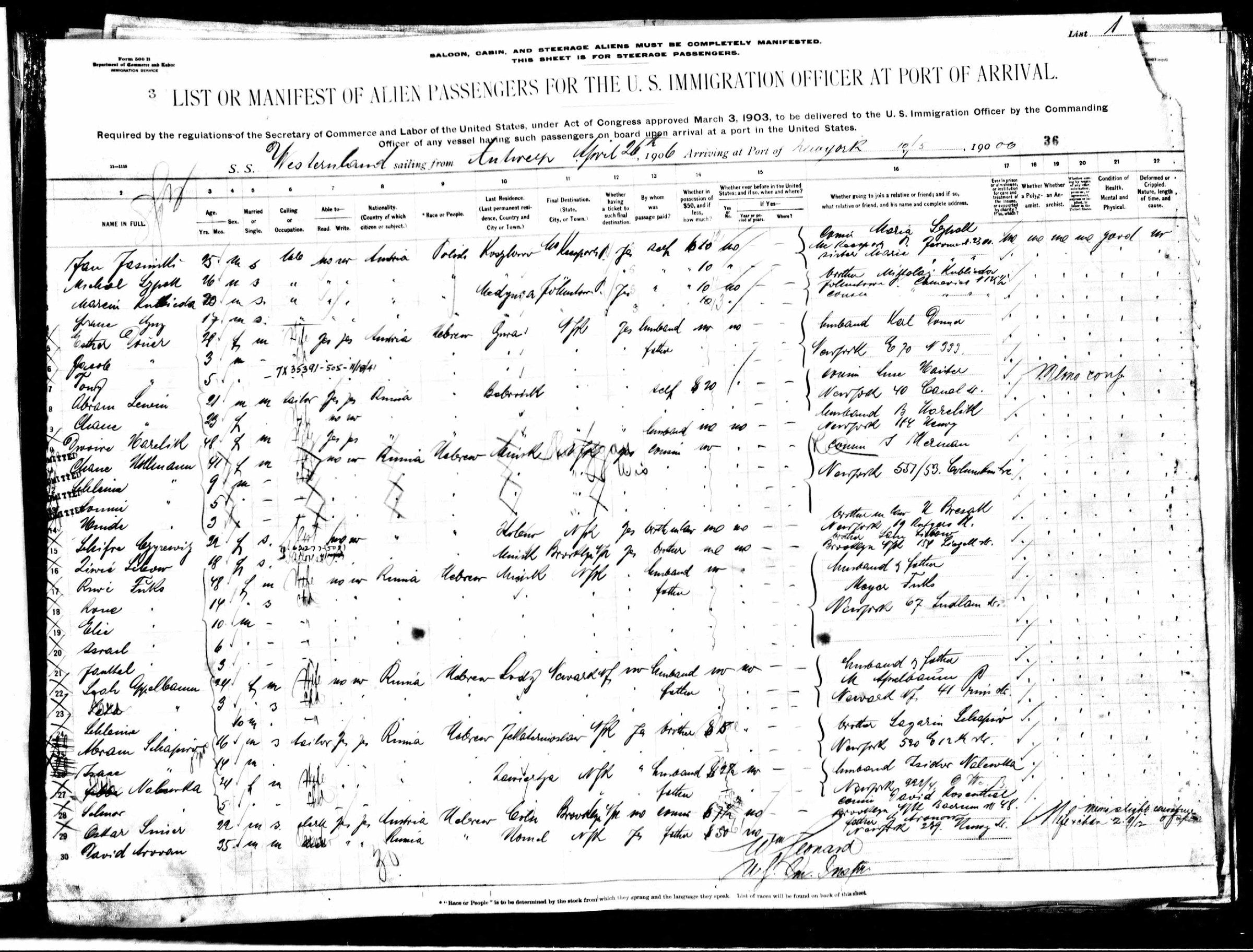
The next line
Sivia is written on the line directly above Reva and her four children.
Ziwie Libow
Line 16. Sivia, age 18.
On the family treeSivia Lebov, on the Lebov sideRinie Fuks
Line 17 is the very next line. It records Reva, with her four children written beneath her. They crossed the ocean together.
On the family treeReva Heft, the mother of the Fox familyElie
Among those four children, on line 19, is my great grandfather Albert, here as a boy under his original name, Elia.
◦ The manifest's child ages are rough; Albert was born in 1892. His given name is recorded as Elia (Albert Elia Ellis Alex Fox), and El'ya in the 1894 Minsk revision list, a household census.
On the family treeAlbert Fox, my great grandfatherThe Foxes and the Lebows crossed on the same ship, written on the same page. Sivia, then Reva, then four of her children, one of them my great grandfather Albert, the same Albert this story started with.
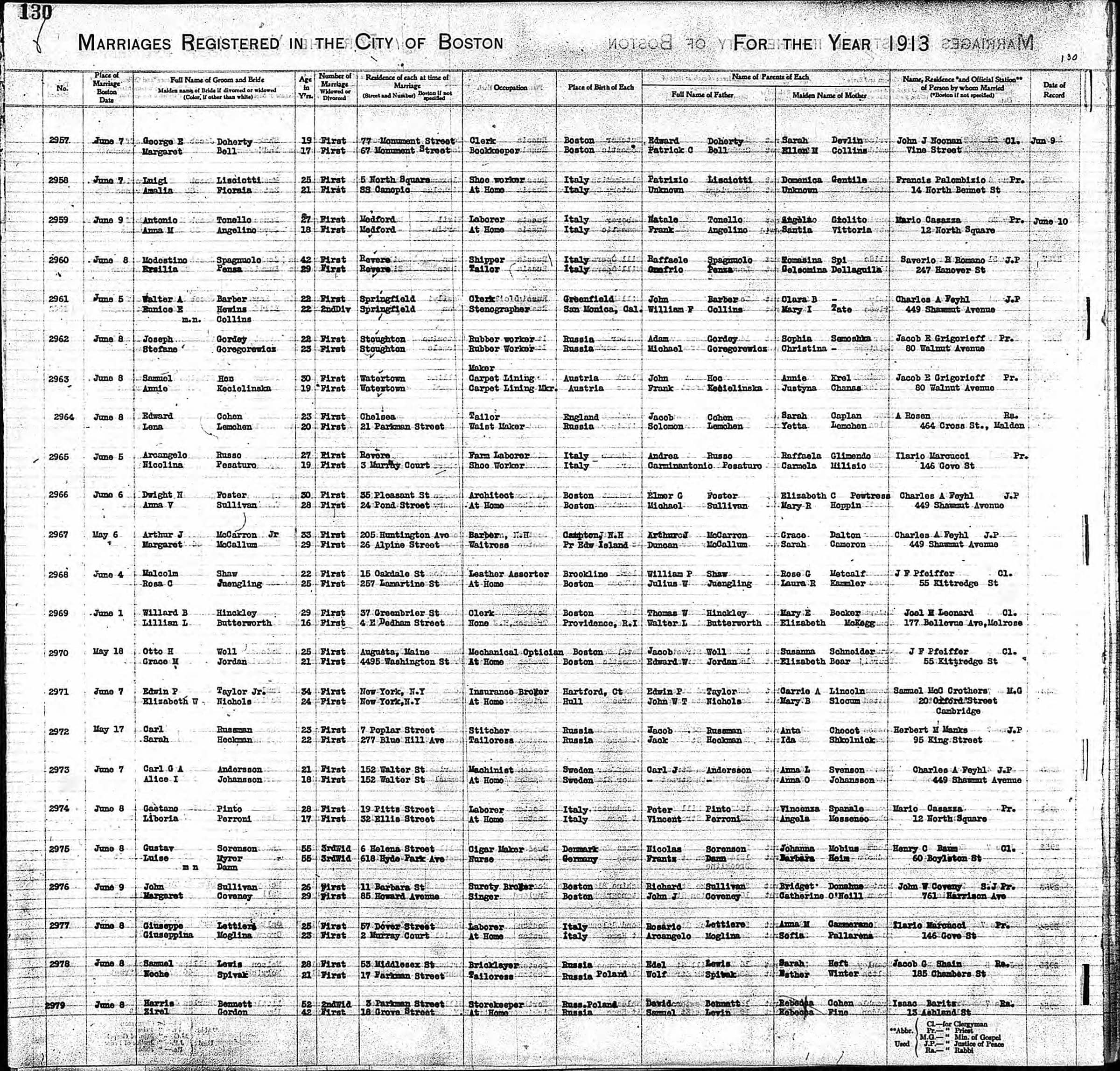
Sivia's records named her parents: her father Iudel-Leiba Lebov, written as Yehuda Leib on her tombstone and Louis Lebow on her marriage record, and her mother, Sora-Malka. Sora-Malka is where the question finally settled. Her son Sam, Sivia's brother, married in Boston in 1913, and the register asked one question Russian records never answered for us: Maiden name of mother.
The clerk wrote: HEFT.
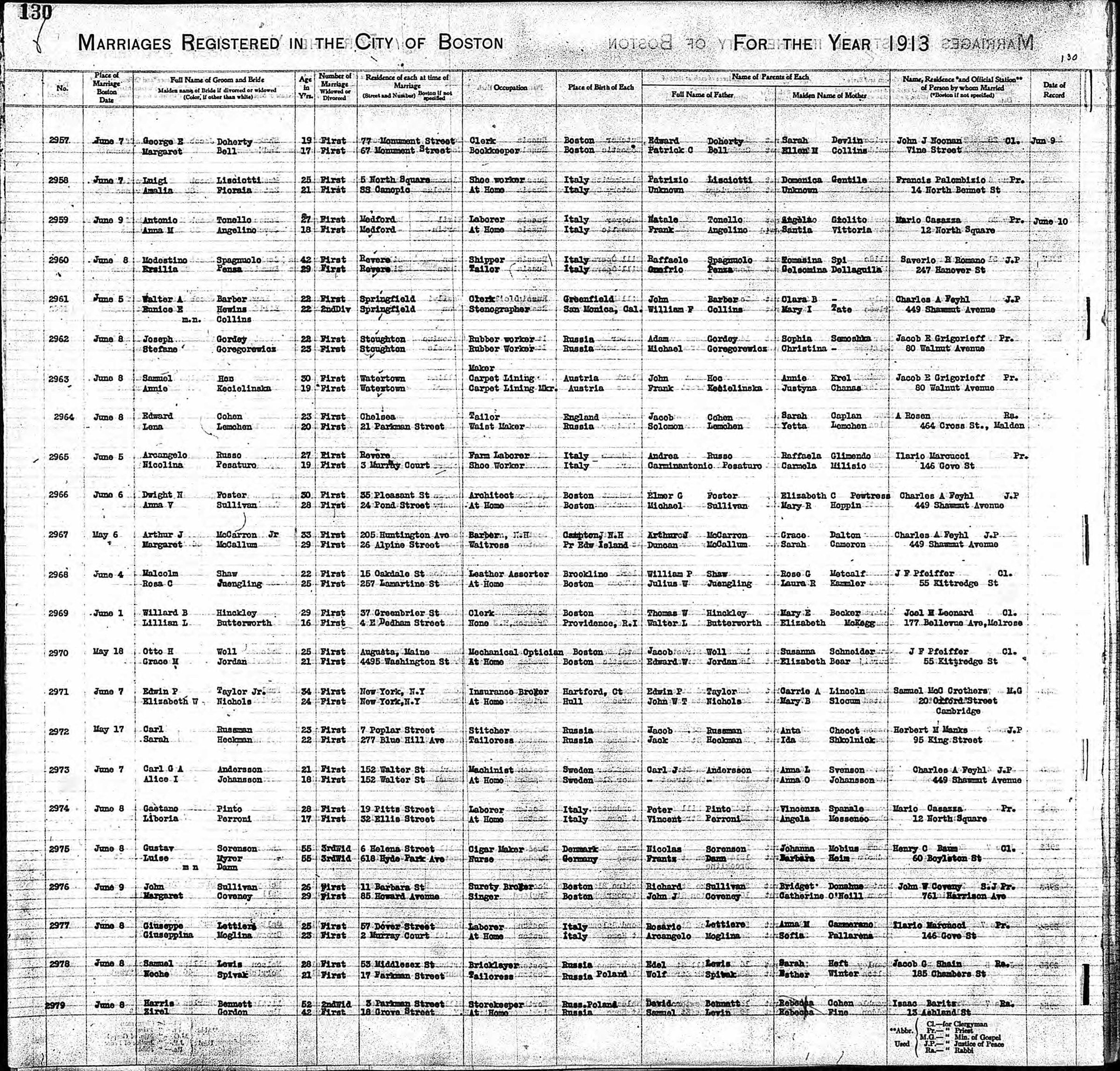
2978 · June 8 · Samuel Lewis · Noche Spivak
Row 2978: Sam, marrying under the name Boston knew him by, Sam Lewis.
Sarah Heft
Maiden name of mother: HEFT. Sora-Malka, written into an American register under the same maiden name as Reva.
Jacob G. Shain · 185 Chambers St
The officiant. The same rabbi had married Sivia in 1907.
Maiden Name of Mother
Sarah Heft
Marriage register, Boston, 1913, row 2978
Their Father's Name
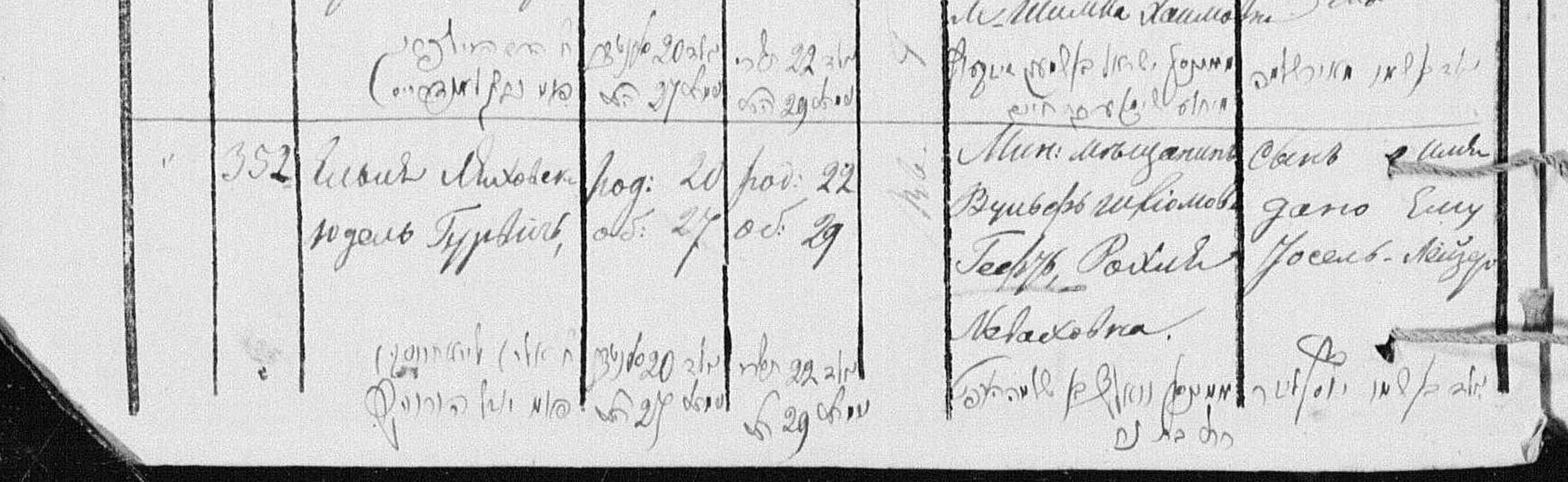
Whether Reva and Sora-Malka were sisters comes down to a single name, their father's. Two Minsk birth records carry it, written into the register in the clerk's own hand, a generation apart. Here is how we read them.
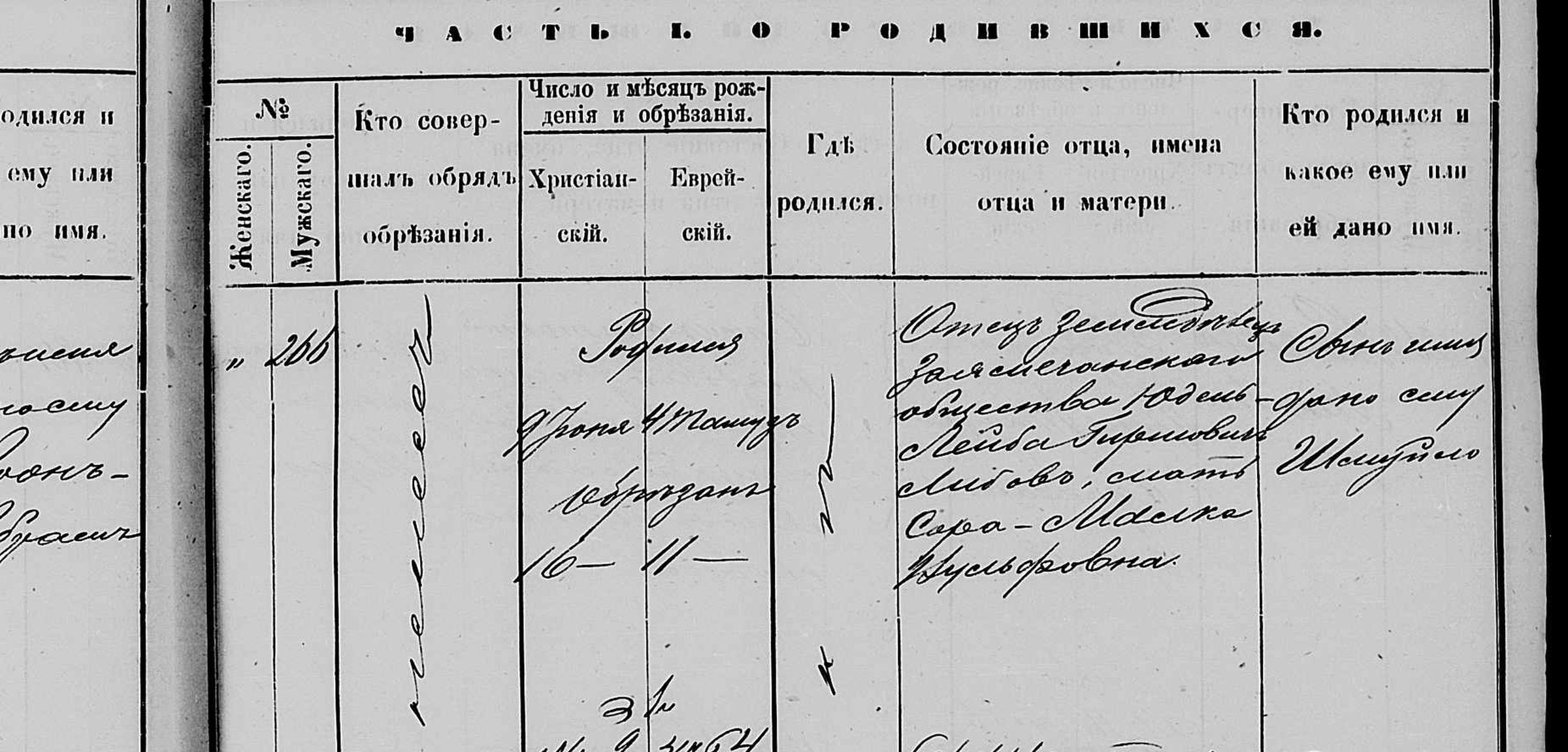
Sora-Malka's father, named
When Sora-Malka's son Sam was born in Minsk in 1882, the register recorded her father's name. Scroll down to read the line that matters.
- As writtenИудель-Лейба Гиршовъ Либовъ
- In lettersIudel-Leiba Girshov Libov
- It readsThe father: Iudel-Leiba, son of Girsh, a farmer of the Zaiamechany colony outside Minsk.
- As writtenСора-Малка Вульфовна
- In lettersSora-Malka Vulfovna
- It readsThe mother: Sora-Malka, daughter of Vulf.
◦ Вульфовна is a patronymic: “daughter of Vulf.” This one word names Sora-Malka's father.
- As writtenШмуйло
- In lettersShmuilo
- It readsTheir newborn son, Shmuilo, the Sam Lebow who would surface in Boston as Sam Lewis.
Sora-Malka's father was Vulf. To see who that Vulf was, we go back another thirty-five years, to the 1847 birth of one of his own children, and to the way the Russian clerks wrote the family's name.
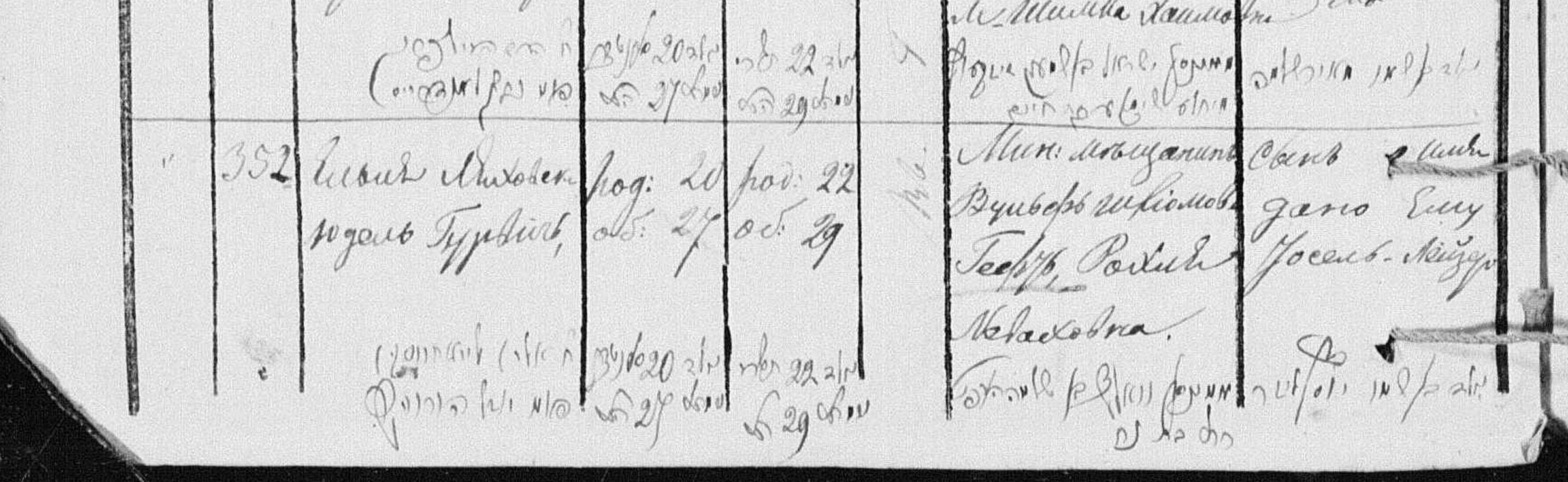
Vulf's household, 1847
An earlier entry from the same Minsk register books names Vulf himself, as a father, with his wife beside him.
- As writtenВульфъ Шлiомовъ Гефтъ
- In lettersVulf Shliomov Geft
- It readsVulf, son of Shlioma, surname Geft. A Minsk townsman.
◦ Гефтъ = Geft. The family's own name was Heft (העפט); Russian has no “H,” so the state clerks wrote it with a hard “G.” Same name, two alphabets.
- As writtenРохля Неваховна
- In lettersRokhla Nevakhovna
- It readsHis wife: Rokhla, daughter of Nevakh. The record gives her father's name but not her maiden surname, so hers stays unknown.
◦ One later record suggests her family name may have been Levy, but this primary record gives only the patronymic, so we leave it open.
- As writtenІосель-Лейзеръ
- In lettersYosel-Leyzer
- It readsTheir son Yosel-Leyzer, one of Reva and Sora-Malka's brothers.
- Гефтъ = the Russian register
- Heft (העפט) = the family's own spelling
- Vulf Geft = Vulf Hersh Heft
- the father of both Reva and Sora-Malka
The Vulf Geft of the Russian records is the Vulf Hersh Heft the family carried in Hebrew, the same father named on Reva's tombstone.
One more independent thread
45 cM
3 segments
An independent AncestryDNA match of 45 cM, across 3 segments, whose family tree names Vulf Hersh Heft and his wife as the shared ancestors, corroborating from a separate branch that Reva and Sora-Malka descend from the same Minsk couple.
Reva's own stone says the same, in two alphabets. The English face reads Rebecca Fox. The Hebrew above it names her father, the same Vulf the Minsk registers gave Sora-Malka.
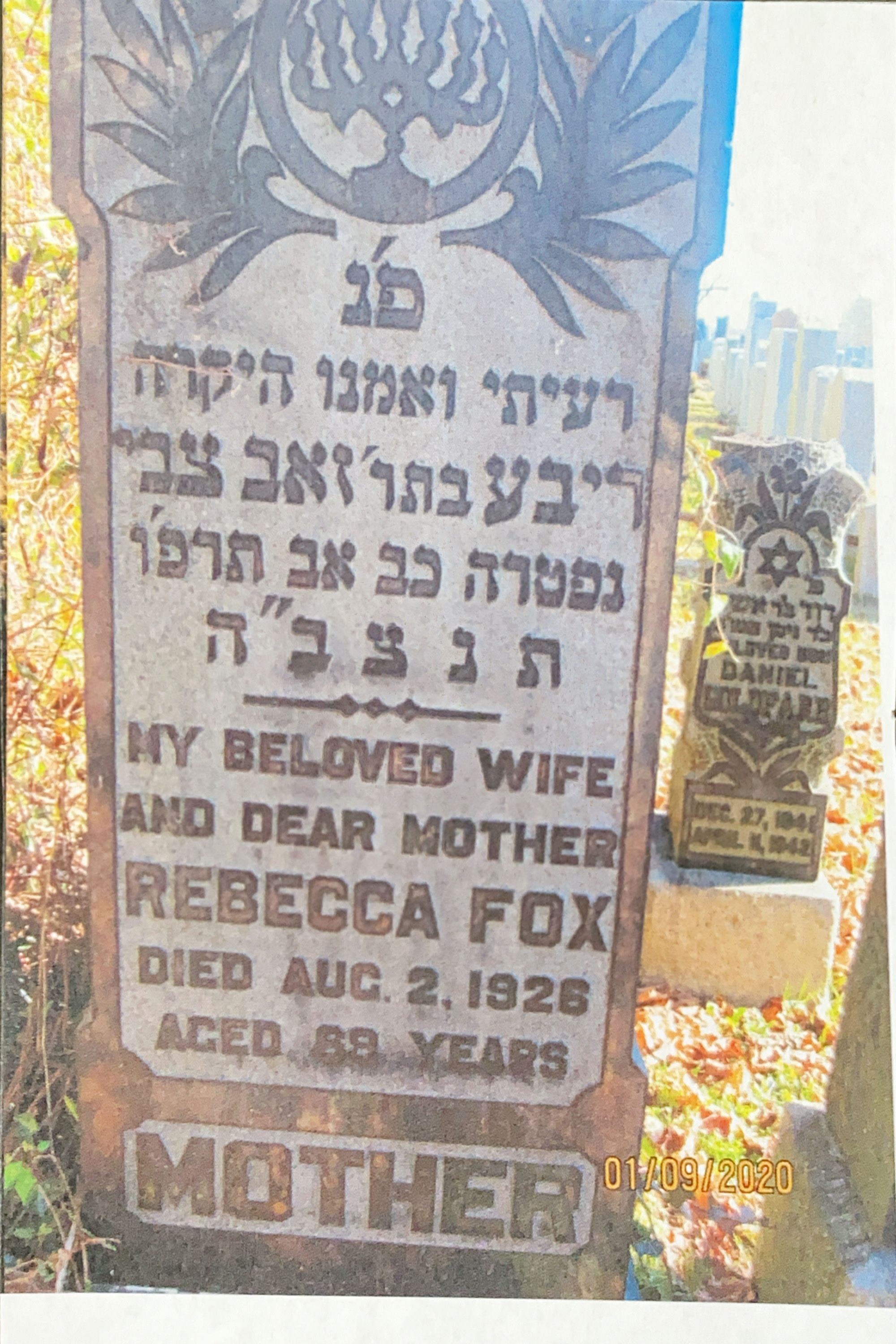
Reading Reva's stone
The carver set her name in Hebrew above her American one. Scroll down to read the line that matters.
- As writtenריבע בת ר׳ זאב צבי
- In lettersRiva bat R' Zeev Tzvi
- It readsReva, daughter of Reb Zeev Tzvi
◦ Zeev means wolf, Tzvi means stag, the Hebrew of the Yiddish name Vulf-Hirsh.
- As writtenREBECCA FOX
- In lettersRebecca Fox
- It readsThe American name she was buried under: Reva Heft, married to Meyer Fox.
- זאב צבי = on the stone, in Massachusetts
- Zeev Tzvi
- Wolf + Stag = Vulf-Hirsh
- Vulf Hersh Heft of Minsk
The father carved on Reva's stone is the same Vulf the Minsk birth registers name as Sora-Malka's father, and so as Reva's too.
One father, three times
The three readings we just decoded name the same man. Here they are, side by side.
1882 Minsk birth register
Sora-Malka, daughter of Vulf.
1847 Minsk birth register
Vulf, son of Shlioma, surname Geft, the Russian spelling of Heft.
Reva's tombstone
Zeev Tzvi, the Hebrew of the Yiddish name Vulf-Hirsh.
- Вульфовна = daughter of Vulf (1882)
- Вульфъ Гефтъ = Vulf Heft (1847)
- זאב צבי = Zeev Tzvi, Vulf-Hirsh (Reva's stone)
- one father, Vulf Hersh Heft
Three records, a generation apart, name one man. He is the father that makes Reva and Sora-Malka sisters.
The three father-name readings, from the 1882 and 1847 Minsk registers and Reva's tombstone, converge on one man, Vulf Hersh Heft, the father Reva and Sora-Malka share.
The stone is sure about her father. It is less sure about her age. It reads aged 68, which would put her birth around 1858, close to the 1859 we publish, but the records never fully agreed on the year.
When was Reva born?
Her records disagree. The conflict stays visible.
Reva's niece Sivia lies under a Massachusetts stone too, and it carries the other half of the picture. Where Reva's stone names her father Zeev Tzvi, the Heft side, Sivia's names her father, Yehuda Leib, the Lebov who married Reva's sister Sora-Malka. Two stones in two cemeteries, each naming a different father in Hebrew, the two branches of one Minsk family that settled in America. She died in 1966 under yet another surname, Landy, possibly from a later marriage, but the stone still carries the old names.
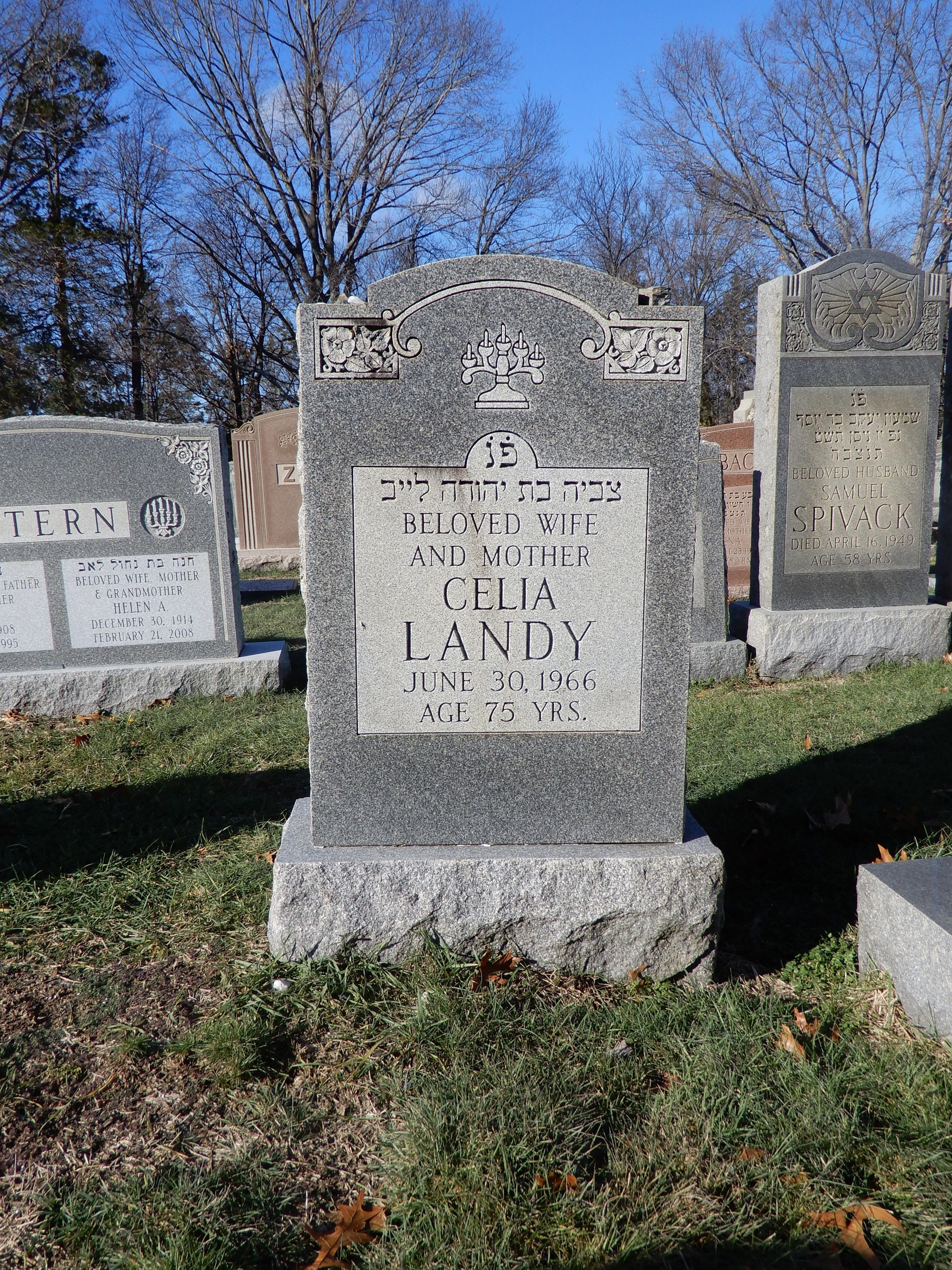
צביה בת יהודה לייב
Tzvia, daughter of Yehuda Leib. Her father's Hebrew name, carved in stone in Massachusetts, matching the Iudel-Leiba of the Minsk records.
◦ AI-assisted reading of the inscription, user-verified against the photograph.
CELIA LANDY · JUNE 30, 1966 · AGE 75 YRS.
The American name she died under. Sivia Lebov, Celia Shear, and finally Celia Landy were all one woman.
◦ The stone's 'age 75' implies a birth around 1890; her records say 1887 or 1888. Small disagreements like this are part of the record.
- Albert Fox and Esther Burd Fox, with their children Leona, Roland, and Charlie.
- Albert was one of Meyer Fox and Reva Heft's eleven children, oldest to youngest: Yudel Noson, Harry, Bessie, Sarah, Sadie, Malka, Rachel, Albert, Leyba, Ervin, and Jack. Eight survived to adulthood; Yudel Noson, Malka, and Leyba died young.
- The Boston uncle, now very likely identified as Hyman Lisitzky (1862 to 1913), still floats unconnected; whether he was a literal blood uncle is an open question.
- A separate family: Iudel-Leiba Lebov and Sora-Malka, with their children Genya, Sam, Sivia, and Chayke.
- Vulf Hersh Heft of Minsk connects the trees: Reva and Sora-Malka were both his daughters, which makes the two women sisters.
One line on a 1913 Boston marriage register gives the first thread: maiden name of mother, HEFT. So Sora-Malka carried the same maiden name as Reva, and the two trees start to come together.
Reva Heft and Sora-Malka Heft, both of Minsk, the same generation. Three records place both women in the Heft family.
- Reva's fatherVulf Hersh (Zev Tzvi) Heft of Minsk, in the household revision lists, 1834–1858.
- Reva's tombstonenames her father in Hebrew, the same Vulf Hersh.
- Sam's 1913 recordhis mother's maiden name, written plainly: HEFT. Sora-Malka was a Heft too.
They were sisters, which makes Sivia a first cousin of my great grandfather Albert. The DNA and the shared father carry it; the birth register that would have named Sora-Malka's parents outright is among the years that don't survive, but it is no longer what the case rests on.
● sisters · both daughters of Vulf Hersh Heft
Close Beside Them
Once I knew who the Lebows were, I started seeing them everywhere in the family's first American decade. In 1911, when Harry's sister Bessie was married at 274 Cherry Street in Manhattan, one of the two witnesses who signed the certificate was Samuel Lebow: Sivia's brother, by our best identification.
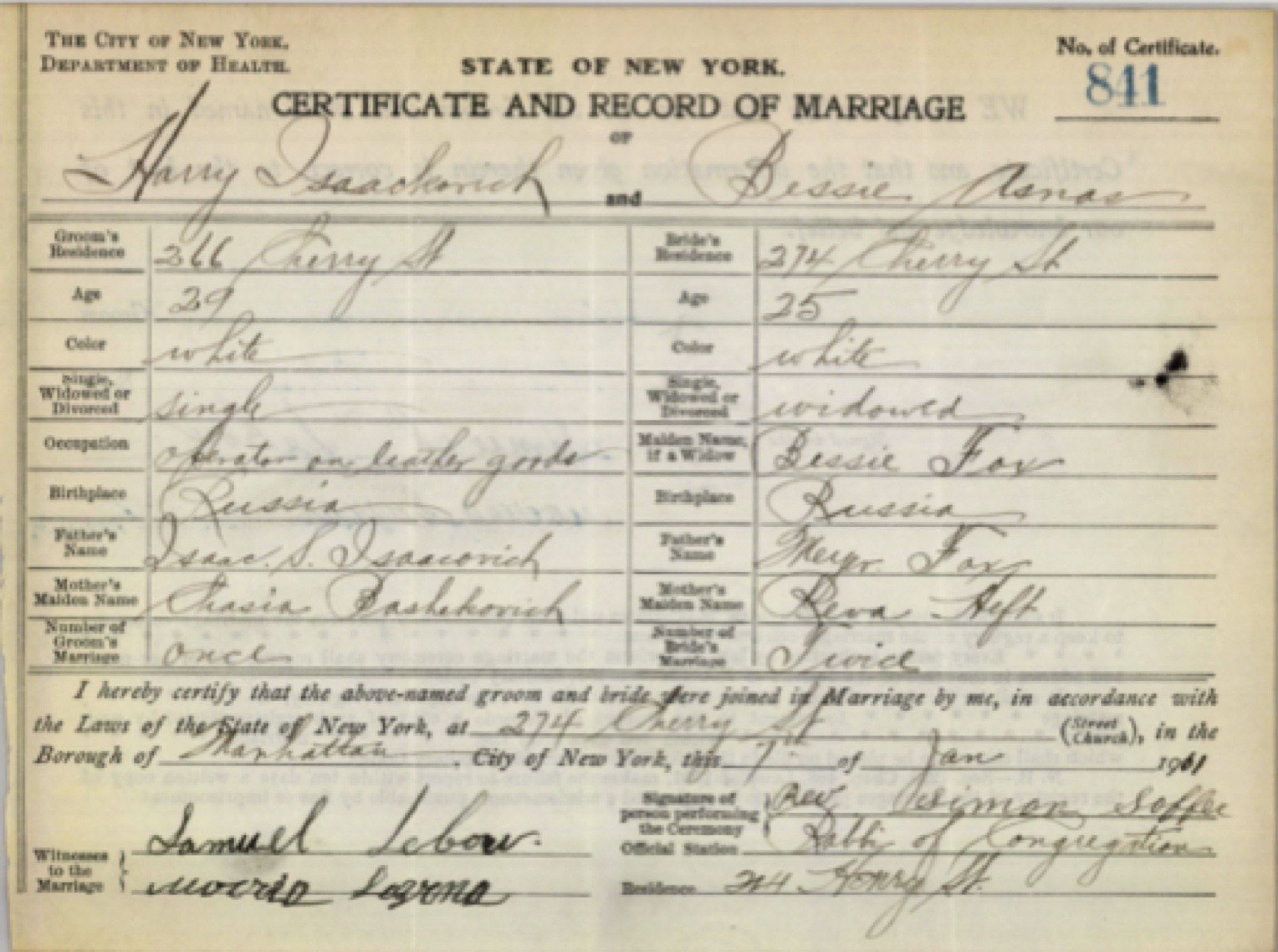
Still close, 1911
A Samuel Lebow signs as a witness at a Fox family wedding. By the family's best reading, he is Sivia's brother Sam.
Samuel Lebow
The first witness signature on Bessie's certificate. A Lebow, signing his own name at a Fox family wedding.
Laid side by side, the documents show a pattern that no single record does. In 1903, Harry lands and is sent not to his father but to a Lebow in Boston. In 1906, Reva crosses the ocean one line above Sivia, her niece. Sivia married in Malden in 1907 and Sam married in Boston in 1913, and the same rabbi, Jacob G. Shain, married them both. In 1911, a Samuel Lebow, probably Sivia's brother Sam, signed as a witness at a Fox family wedding in Manhattan.
No one of these is a big event on its own. But you do not get pointed to a man's house, cross an ocean beside him, share a rabbi, and sign each other's wedding papers unless you are still in each other's lives, and they kept it up for at least a decade in the records that survive. The memory lasted longer than the paperwork. A century later, a note in a cousin's family tree still kept the story that her grandmother "came over with Reva Heft Fuks."
1903
Harry lands; his manifest names a Lebow uncle in Boston
documented
1906
Reva and Sivia cross on the same ship, adjacent lines
documented
1907 / 1913
Sivia and Sam married by the same rabbi, Jacob G. Shain
documented
1911
Sam signs as witness at Bessie's wedding
documented, identification per our best reading
| Year | Event | Confidence |
|---|---|---|
| 1903 | Harry lands; his manifest names a Lebow uncle in Boston | documented |
| 1906 | Reva and Sivia cross on the same ship, adjacent lines | documented |
| 1907 / 1913 | Sivia and Sam married by the same rabbi, Jacob G. Shain | documented |
| 1911 | Sam signs as witness at Bessie's wedding | documented, identification per our best reading |
“came over with Reva Heft Fuks”
The name itself
HEFT
in Minsk records also Geft: Yiddish heft
“a copy-book, a notebook”
Per Alexander Beider, A Dictionary of Jewish Surnames from the Russian Empire (s.v. Geft, Minsk). A related reading ties the neighboring surname Gaft to haft, “embroidery.” Both readings are preserved here rather than resolved. What a name meant is not a record of what its bearers did.
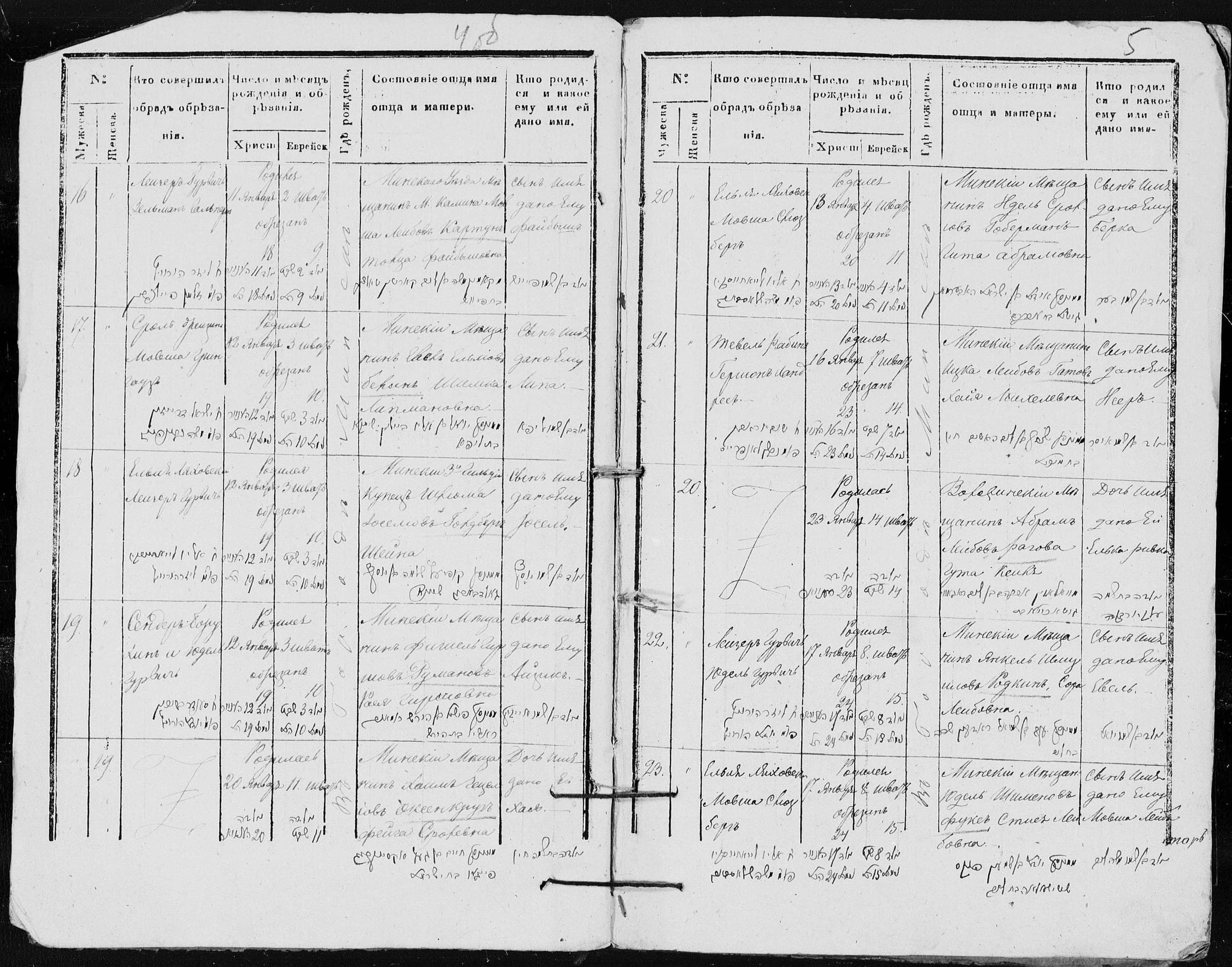
The records that should tell the Hefts' story are mostly gone, or were never made. The register pages that would carry Reva's and Sora-Malka's births do not survive; what remains are books like this one, from the same shelf, the neighboring years.
I grew up knowing almost nothing about this side of the family, one maiden name on a couple of certificates. The research eventually mapped the Hefts of Minsk back several generations. It was the family Reva left behind around the turn of the century that seemed to vanish, and it took one wrong photograph to find where part of it went. They had been here the whole time, in Boston and in New York, one line over from Reva's family in record after record.
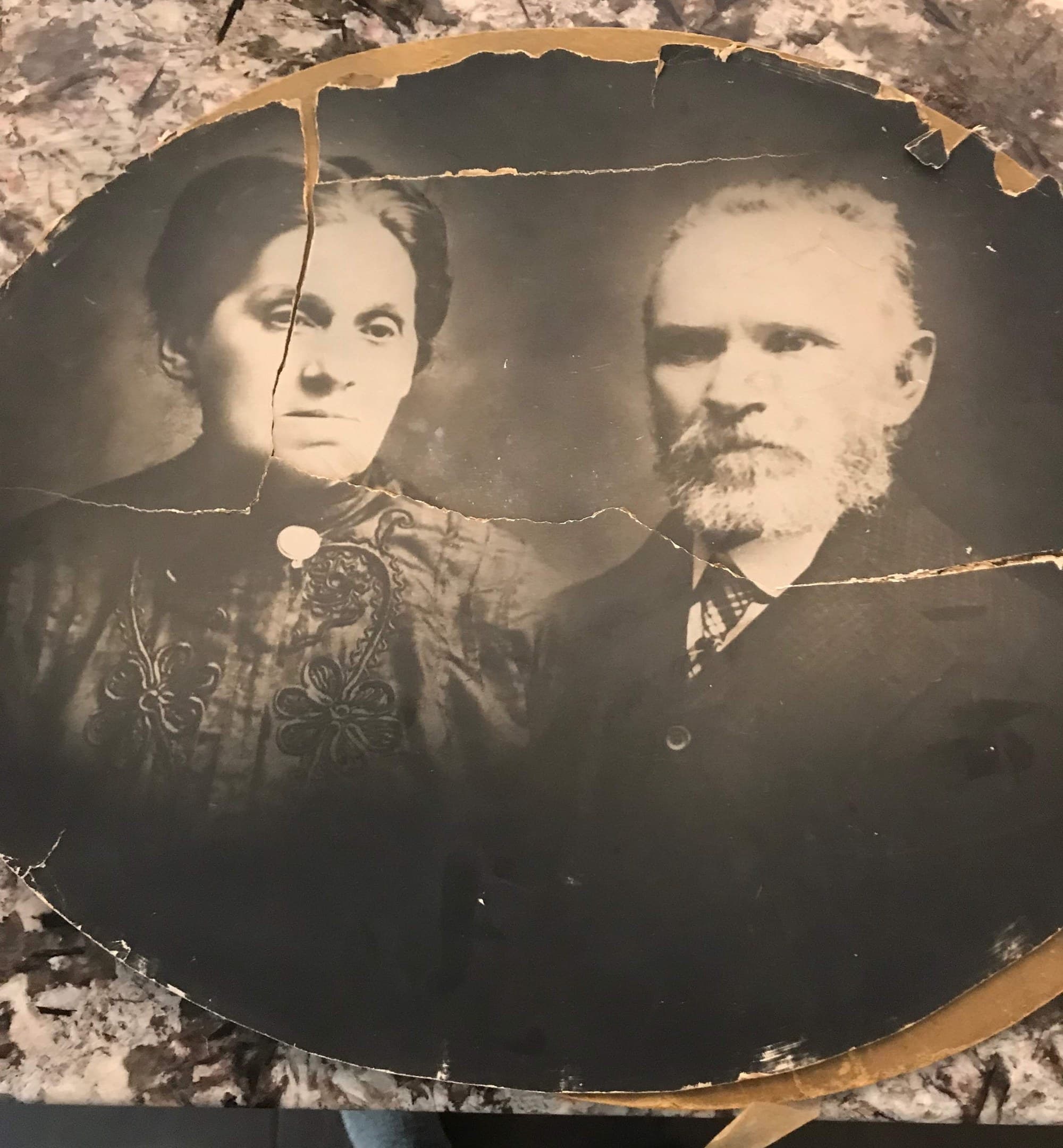
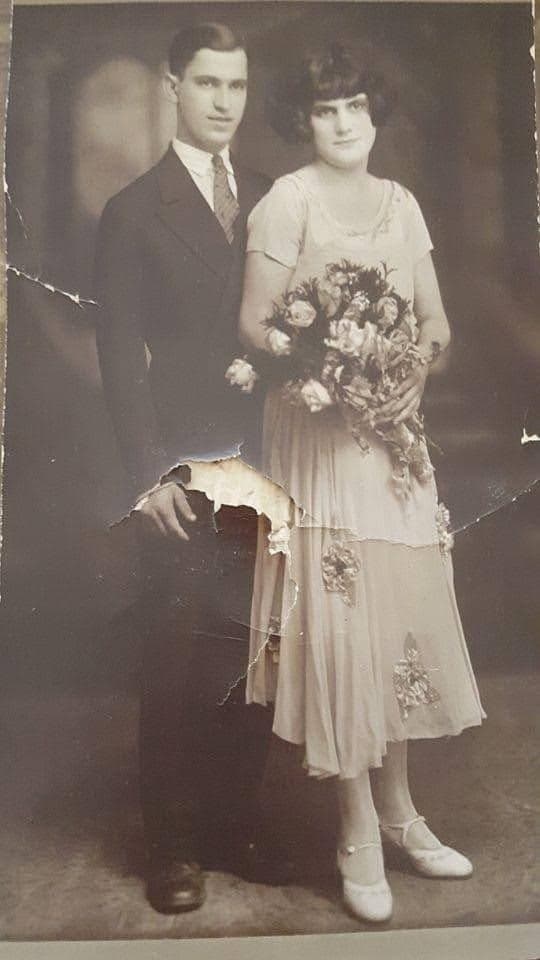
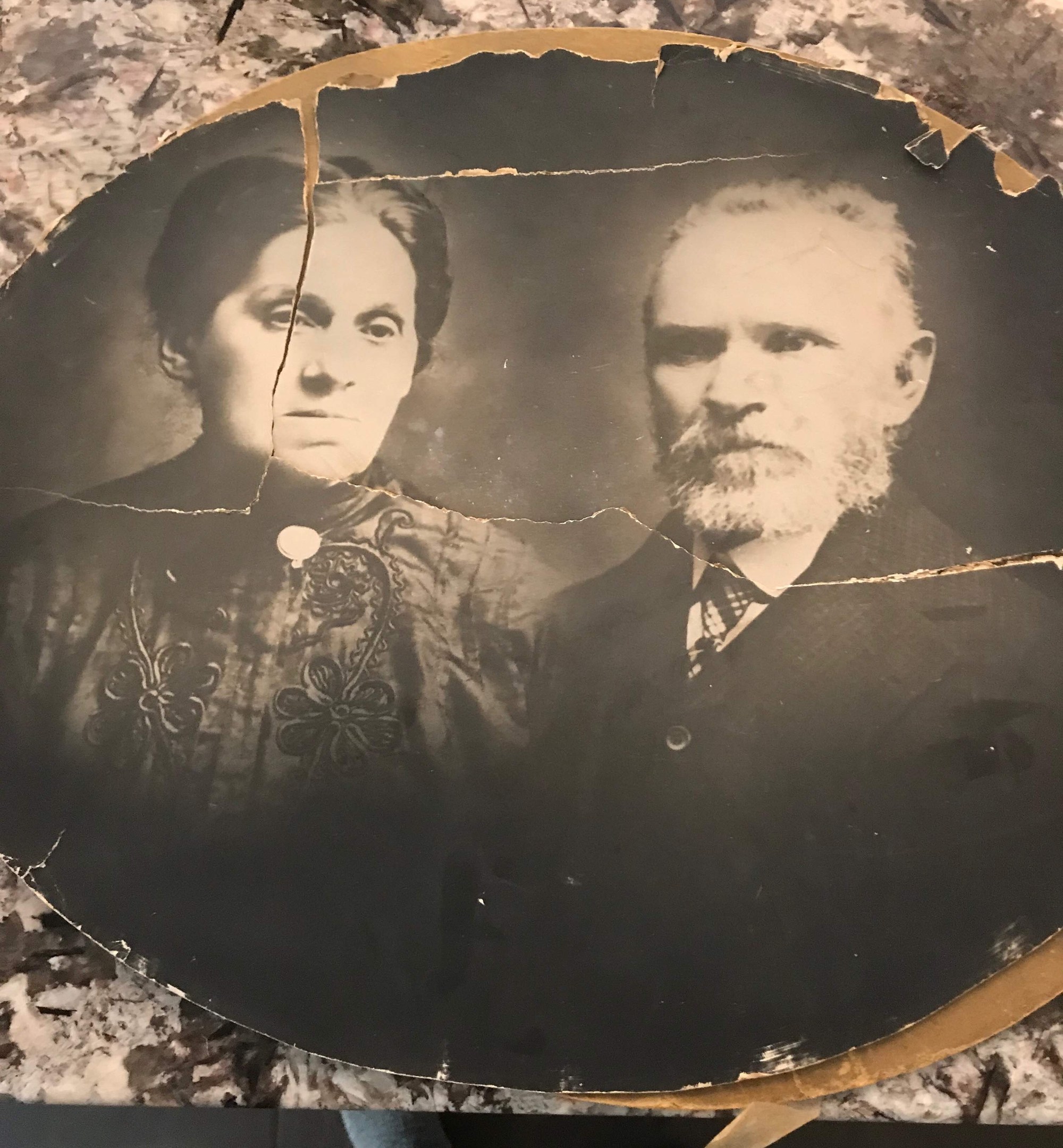
The photograph of Reva and Meyer that survives is cracked across the middle and torn at the edges, and I used to read it as one family. I now know it holds two. The Lebows are on the next line of the manifest, at Bessie's wedding in Manhattan, and at the Boston address the clerks kept writing down.
I keep going back to the Belle Isle photograph this story started with. I still cannot tell you who the man standing in the middle is, and that stays open. But I can tell you who is around him now. The wrong name on one face is what sent me looking for the right one, and the right one led to a whole branch of the family that had been out of reach for years. I went in trying to name one man. I came out having found a family instead.
- Albert Fox and Esther Burd Fox, with their children Leona, Roland, and Charlie.
- Albert was one of Meyer Fox and Reva Heft's eleven children, oldest to youngest: Yudel Noson, Harry, Bessie, Sarah, Sadie, Malka, Rachel, Albert, Leyba, Ervin, and Jack. Eight survived to adulthood; Yudel Noson, Malka, and Leyba died young.
- The Boston uncle, now very likely identified as Hyman Lisitzky (1862 to 1913), still floats unconnected; whether he was a literal blood uncle is an open question.
- A separate family: Iudel-Leiba Lebov and Sora-Malka, with their children Genya, Sam, Sivia, and Chayke.
- Vulf Hersh Heft of Minsk connects the trees: Reva and Sora-Malka were both his daughters, which makes the two women sisters.
The whole tree, as the records let us draw it today. Two families, one puzzle, assembled from manifests, registers, tombstones, and DNA.
Every line above runs through two people.
Reva Heft and Meyer Fox. Family collection. Shown as it survives, unrestored.
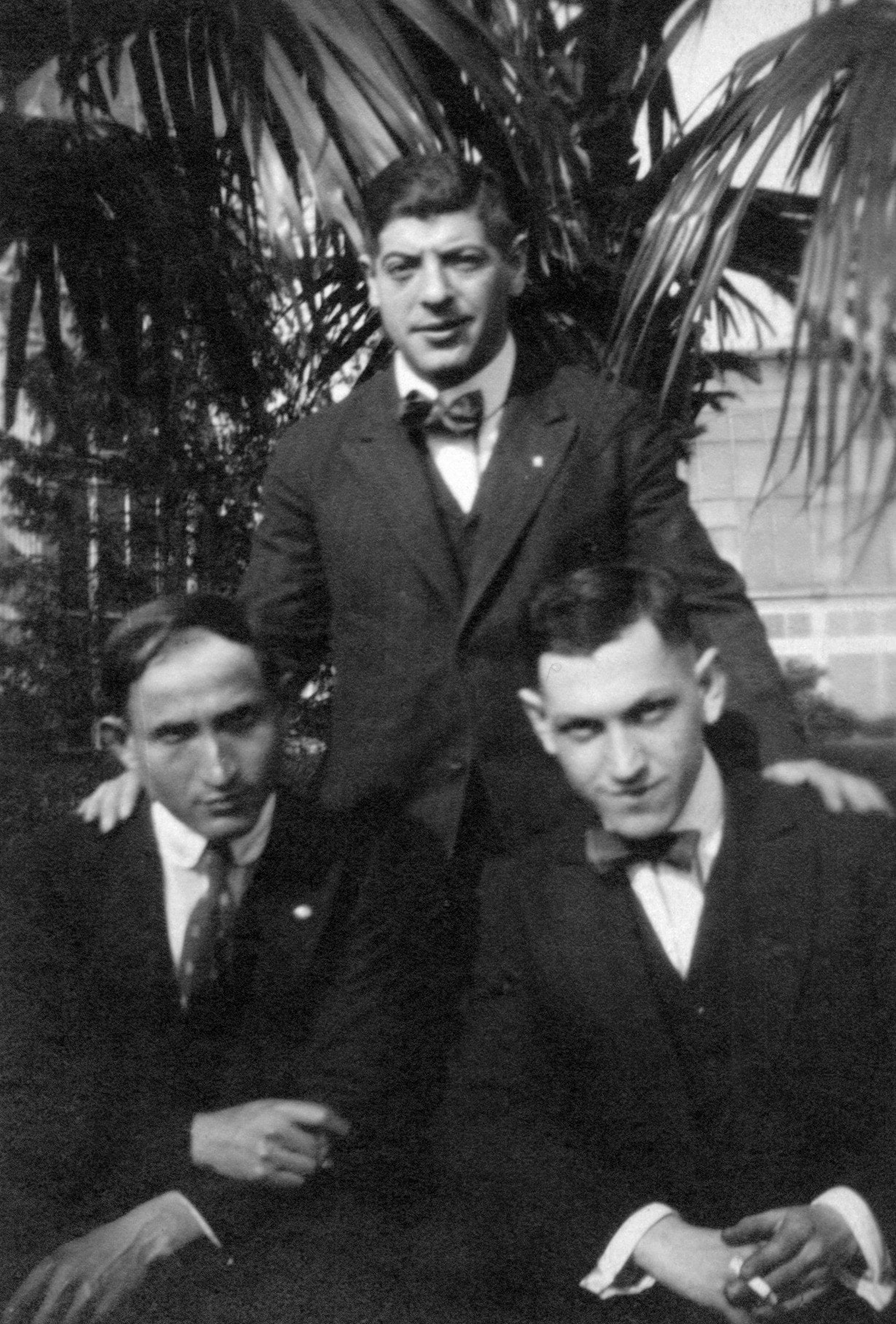
The Belle Isle photograph at the center, ringed by the family found in the records: Sivia and Reva from the 1906 crossing, Sam from a 1913 Boston marriage register, and Vulf, the father the two sisters shared. The man standing in the middle is still unidentified.